
Introduction: The Service Nobody Explains Clearly
Search for flights to Vietnam and you’ll eventually run into “Airport Fast Track” — offered by dozens of agencies, described in a dozen slightly different ways, and rarely explained in plain terms. Is it a visa service? A lounge pass? Something only for VIPs? None of those, exactly.
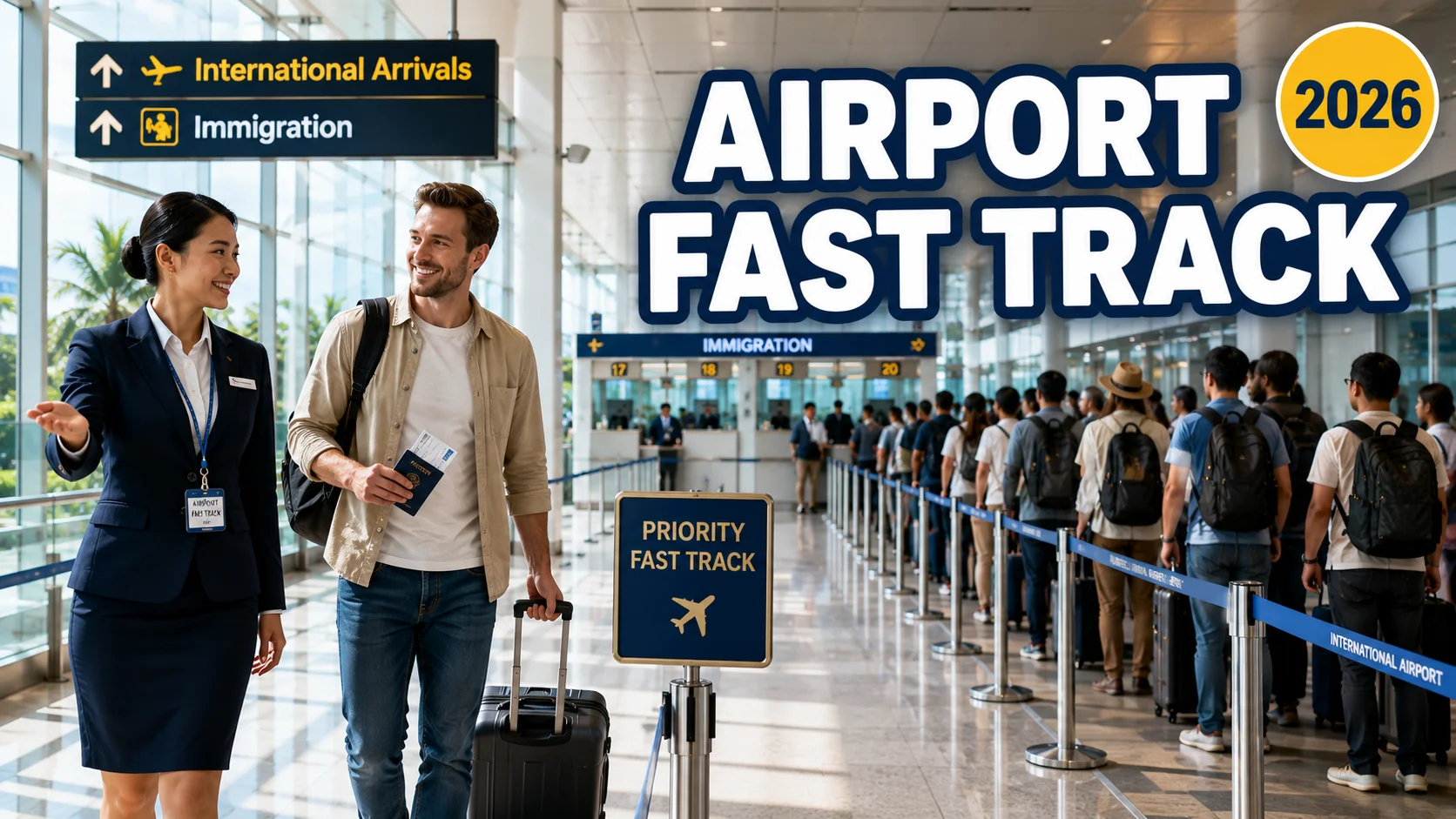
Airport Fast Track is a paid, private meet-and-greet service: a staff member meets you at the airport, holding a sign with your name, and guides you through a priority lane at immigration — bypassing the general public queue entirely. It has nothing to do with your visa itself; it’s entirely about the physical experience of moving through the airport.
This guide explains exactly what’s included, what it typically costs, and — more importantly — who actually benefits enough to justify paying for it.
Why This Service Exists in the First Place
Vietnam’s busiest international airports handle enormous passenger volume in short bursts. At Tan Son Nhat International Airport (SGN) in Ho Chi Minh City, for example, immigration lines can take anywhere from 30 minutes to over 2 hours, depending entirely on how many wide-body flights land within the same window — a purely physical bottleneck of people versus counters, unrelated to anyone’s paperwork being in order or not.
This pattern repeats, to varying degrees, across Vietnam’s other major international gateways — Noi Bai (Hanoi), Da Nang, Cam Ranh (Nha Trang), and Phu Quoc. Airport Fast Track exists specifically to solve this bottleneck: instead of joining hundreds of other arriving passengers in a shared queue, you’re escorted through a separate, prioritized lane.
What’s Actually Included: A Representative Example
While specifics vary slightly by airport, most Fast Track services in Vietnam — including ours — are structured around two tiers:
Standard Fast Track covers the core bottleneck: an assistant meets you in the arrival hall, just before immigration, holding a name sign, and guides you through a shared priority lane at passport control. On departure, an assistant meets you after you’ve checked in yourself, and escorts you through priority security and immigration lanes. This tier is built for travelers who mainly want to skip the passport control queue itself.
VIP Fast Track meets you at the same point but goes further: a dedicated, separate VIP-only immigration lane (rather than a shared fast-track lane), plus baggage retrieval assistance, a customs escort, and — on arrival — being walked all the way to your waiting car or driver. On departure, the VIP assistant helps with check-in itself, escorts you through security and immigration, and walks you into the departure security/isolation area, with business lounge access available on request.
A representative price point: at Tan Son Nhat, Standard Fast Track runs around $30 USD per person per direction, and VIP around $65 USD per person per direction, with a modest surcharge (roughly $10 USD) for late-night or red-eye flights. Pricing at each airport is confirmed on that airport’s specific page, since group size, season, and exact route can affect the quote.
Important: Fast Track is entirely separate from your visa. It does not replace the need for a valid e-visa, visa on arrival, or visa exemption — in the VIP tier, an assistant can help you through visa-on-arrival stamping faster, but the visa itself must still be arranged in advance.
Is It Worth It? It Depends on Who You Are
This is really the core question, and the honest answer is: it depends on your specific trip, not a blanket yes or no.
Likely worth it if you’re:
- A first-time visitor unfamiliar with Vietnamese airport layout and procedures, where guided assistance reduces stress regardless of queue length
- A business traveler with a tight connection, meeting, or onward flight where an unpredictable hour-plus wait is a genuine risk
- Traveling with young children or elderly family members, where standing in a slow-moving line is physically harder than for a solo adult traveler
- Landing during a known peak window — early morning or evening arrivals, national holidays, or Tet, when multiple wide-body flights commonly land close together
- Someone who simply values predictability over saving $30–65, especially after a long-haul flight
Probably not necessary if you’re:
- Arriving at an off-peak time with few other flights landing simultaneously
- Not time-constrained — no tight connection, no evening plans, comfortable waiting an extra 20–40 minutes
- Traveling light and solo, comfortable navigating an unfamiliar airport independently
- Simply looking to minimize costs on a backpacking-style budget trip, where the time saved doesn’t outweigh the expense for your situation
Neither group is “wrong” — Fast Track is a genuine convenience service, not a necessity, and Standard tier pricing (commonly around $30 per person) makes it accessible enough that many travelers treat it as a small, worthwhile comfort purchase rather than a major expense.
Standard vs. VIP: Which Tier Actually Fits You
A quick way to decide between tiers: Standard solves the queue problem. VIP solves the queue problem plus the “I don’t want to think about logistics at all” problem.
- Choose Standard if your main concern is simply the immigration line itself, and you’re happy to handle check-in, baggage claim, and finding your driver on your own.
- Choose VIP if you want a fully escorted experience — help with check-in, someone carrying your bags, a customs escort, and being walked straight to your car — particularly valuable for elderly travelers, families with multiple bags, or anyone arriving exhausted from a very long flight.
Doing the Math: What Are You Actually Paying For?
It helps to frame Fast Track less as a “luxury airport service” and more as a straightforward time purchase. If a Standard package costs around $30 per person and saves you anywhere from 30 minutes to over an hour during a peak arrival window, that works out to roughly the price of an airport meal or a short taxi ride — trading a fixed, modest cost for an uncertain amount of standing-in-line time that’s genuinely hard to predict in advance.
For a family of four landing during a busy evening slot, that calculation changes further: the time saved multiplies across every member of the group, while jet lag, tired children, and heavy luggage all make an unpredictable hour-long wait considerably harder to absorb than it would be for a single well-rested solo traveler. This is generally why families and groups report higher satisfaction with Fast Track relative to its cost than solo travelers arriving at quieter times.
Arrival, Departure, or Both?
Most travelers think of Fast Track purely as an arrival service — the moment you land, tired and eager to get to your hotel. But departure Fast Track solves a real, separate problem too: getting through security and immigration on your way out, particularly at airports where departure queues can build up during peak outbound travel windows (commonly early morning and late evening).
Some travelers book Fast Track for arrival only, treating it as a way to start their trip smoothly after a long flight, while saving cost on departure since there’s generally more flexibility in arrival timing at the airport before a flight than there is on landing. Others book both directions, particularly if their return flight also falls during a known busy period, or if the added peace of mind is worth the modest additional cost either way. There’s no universally correct choice here — it comes down to your own schedule, budget, and how much airport logistics you’d rather not think about on a given day.
Booking for Groups or Connecting Passengers
Fast Track bookings aren’t limited to a single traveler. Group bookings — families traveling together, tour groups, or colleagues on a business trip — are commonly arranged as a single booking covering multiple people, and most providers, including us, are able to quote group or round-trip pricing on request rather than charging strictly per-person rates in every case. This is worth asking about directly if you’re booking for more than two or three travelers, since it can meaningfully change the per-person cost.
If you’re on a connecting flight and only transiting through Vietnam briefly, it’s also worth checking directly whether Fast Track applies to your specific itinerary, since transit passengers who don’t formally clear immigration may not need — or be eligible for — an arrival Fast Track service in the same way as passengers ending their journey in Vietnam.
How Airport Fast Track Differs from Visa Speed Services
It’s worth being clear about one common point of confusion: Airport Fast Track has no effect on how quickly your visa is approved. If you’re also concerned about visa processing time — whether you haven’t applied yet, or your application is stuck in “processing” — that’s a separate question entirely, covered in our guide on Emergency E-Visa vs Expedited Service vs Airport Fast Track. Many travelers under real time pressure end up using both a visa speed service and Fast Track together, since they solve entirely different bottlenecks — one before you fly, one the moment you land.
Booking Fast Track at Your Specific Airport
Fast Track is arranged individually per airport, since meeting points, pricing, and exact procedures are specific to each location:
- Noi Bai Airport Fast Track (Hanoi)
- Tan Son Nhat Airport Fast Track (Ho Chi Minh City)
- Da Nang Airport Fast Track
- Cam Ranh Airport Fast Track (Nha Trang)
- Phu Quoc Airport Fast Track
Each page includes exact package details, current pricing, and a direct booking process for that specific airport.
Frequently Asked Questions
1. What is Airport Fast Track, in one sentence? It’s a paid meet-and-greet service where a private assistant escorts you through priority lanes at immigration (and, in higher tiers, security, customs, and baggage claim) at a Vietnamese international airport.
2. Does Fast Track replace my Vietnam visa? No. It’s an airport assistance service only — you still need a valid e-visa, visa on arrival, or visa exemption to enter the country; the visa itself is arranged separately.
3. Is Fast Track only for wealthy or VIP travelers? No — Standard tier pricing (commonly around $30 per person) is accessible to most travelers, and many book it simply as a convenience, not a luxury purchase.
4. Does the price differ between airports? Yes, pricing and package specifics vary slightly by airport based on local logistics — check the specific airport page for current, exact pricing.
5. Will Fast Track guarantee I skip the queue completely? It significantly reduces or bypasses the general public queue via a priority lane, though it’s a private airport service rather than an official government guarantee.
6. Can I book Fast Track for family members not traveling with me? Typically yes — most bookings can be arranged on behalf of another traveler by providing their flight details, so an assistant can meet and guide them independently.
7. Is Fast Track available for domestic flights within Vietnam? It’s generally designed for international arrivals and departures, where immigration and customs procedures apply — check your specific airport’s page to confirm availability for your route.
8. How far in advance should I book? Booking at least 24–48 hours ahead is generally recommended, though last-minute requests can sometimes be accommodated — contact support directly to check availability close to your travel date.
9. What happens if my flight is delayed? Reputable Fast Track services track your flight in real time and adjust automatically, meeting you whenever you actually land rather than at your originally scheduled time.
10. Should I book Fast Track and a visa speed service together? If you’re both worried about visa processing time and airport queues, yes — they solve different problems and can be arranged independently of each other. See our comparison of visa speed services if that applies to you.
Ready to Skip the Queue?
Choose your arrival or departure airport below to see exact packages, current pricing, and book your Fast Track service in minutes.
👉 Message us on WhatsApp or by email to get started, or head directly to your airport’s page: Noi Bai · Tan Son Nhat · Da Nang · Cam Ranh · Phu Quoc
This article is for general informational purposes and reflects publicly available guidance current at the time of writing. Exact packages and pricing are confirmed on each airport’s specific page and may change.
