
Introduction: Speed Isn’t Just About the Visa
When a Vietnam trip comes together fast — a last-minute flight, a sudden business trip, a visa application that’s stuck in limbo — most travelers immediately search for “how fast can I get a Vietnam visa.” But visa approval speed is only half the story. The other half is what happens after you land: how long you actually spend standing in an immigration queue at the airport.
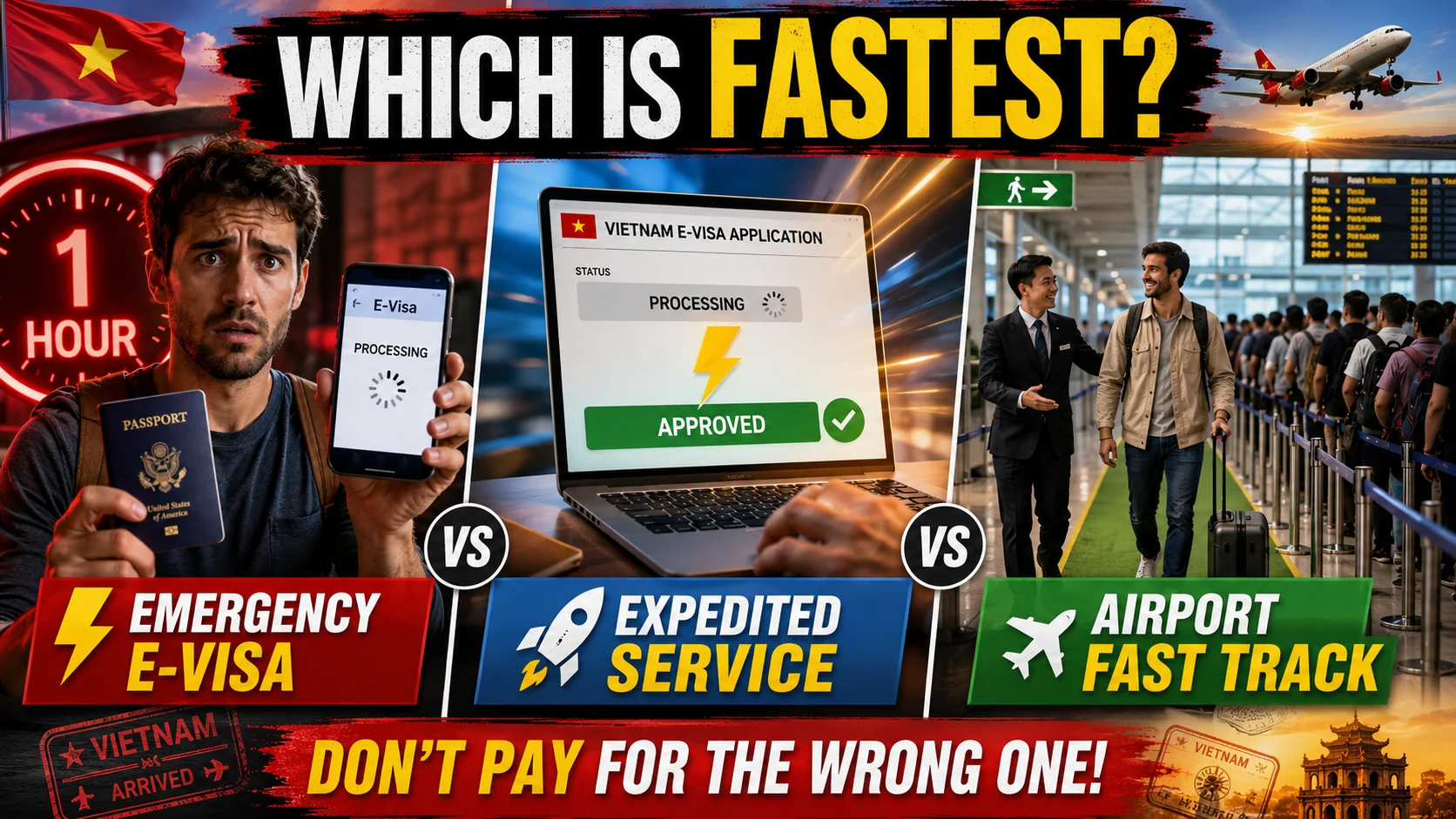
Vietnam Visabox offers three services that each solve a different piece of this puzzle — Emergency E-Visa, E-Visa Expedited Service, and Airport Fast Track. They’re easy to confuse because they all promise speed, but they solve entirely different problems. This guide breaks down which one (or combination) actually fits your situation.
The Three Services, in Plain Terms
- Emergency Vietnam Visa — for travelers who haven’t applied yet and need a brand-new e-visa processed on short notice, in as little as 1 working hour.
- Vietnam E-Visa Expedited Service — for travelers who already submitted an e-visa application that’s still stuck in “processing,” and need that existing application accelerated.
- Airport Fast Track (available at Noi Bai, Tan Son Nhat, Da Nang, Cam Ranh, and Phu Quoc) — a completely separate service that has nothing to do with your visa’s approval speed. It’s about skipping the immigration queue itself once you land, with a staff member meeting you at the aircraft door or jet bridge and guiding you through a priority lane.
The key distinction to hold onto: Emergency E-Visa and Expedited Service both get your visa approved faster before you fly. Airport Fast Track gets you through the airport faster after you land. Many travelers under time pressure actually need both — a fast visa approval and a fast arrival experience — but they’re solving different bottlenecks.
Which One Applies to You? Start Here
The fastest way to figure out which service you need is to ask one question: have you already submitted an e-visa application or not?
- Haven’t applied at all, and your flight is in a few days? → You need the Emergency E-Visa service — a brand-new application, processed urgently.
- Already applied, and it’s been sitting in “processing” for days? → You need the Expedited Service — no need to reapply, just accelerate what’s already submitted.
- Your visa is sorted (or about to be), but you’re worried about immigration queues on arrival? → Airport Fast Track is the service you’re actually looking for — it doesn’t touch your visa at all.
Side-by-Side Comparison
| Factor | Emergency E-Visa | Expedited Service | Airport Fast Track |
|---|---|---|---|
| Solves | No visa applied yet | Existing application stuck in “processing” | Slow immigration queue after landing |
| Requires new application? | Yes | No — works with existing application | No — separate service entirely |
| Fastest turnaround | As fast as 1 working hour | As fast as 1 working hour | Same-day, arranged before your flight lands |
| What you need to provide | Passport photo, portrait photo, travel dates | E-visa application code + email used | Flight number and arrival time |
| Where it applies | Before you fly | Before you fly | The moment you land |
| Can be combined with the others? | N/A (this is the visa itself) | N/A (this is the visa itself) | Yes — works alongside either visa option |
Real Scenarios: What Actually Fixes Your Problem
“My flight is in 3 days and I haven’t started my visa application yet.” This is squarely an Emergency E-Visa situation — a new application, processed under time pressure. Airport Fast Track isn’t relevant yet since you don’t have an approved visa to travel on.
“I applied 4 days ago, my flight is tomorrow, and the status still says ‘processing.'” This is the Expedited Service — your application already exists, it just needs to be accelerated through the review queue. Reapplying from scratch would only slow things down further.
“My visa is already approved, but I’ve heard Tan Son Nhat’s immigration lines can take over an hour during peak evening arrivals.” Your visa situation is fine — what you need here is Airport Fast Track, which has nothing to do with visa processing and everything to do with skipping the physical queue once you land.
“I’m applying for an emergency visa AND I’m worried about the queue when I land at a busy airport.” Both services can run in parallel: an Emergency E-Visa gets your entry document ready before departure, and Airport Fast Track is arranged separately for your arrival — booking one doesn’t require or replace the other.
“I don’t know if my application is ‘processing’ or ‘awaiting payment.'” This distinction matters more than it sounds like it should. Expedited processing only applies once an application shows genuinely “pending” or “processing” — if payment hasn’t gone through yet, that needs to happen first through the standard e-visa system before any acceleration service can help. If you’re not sure which state your application is in, it’s worth a quick message to a specialist before choosing a paid tier.
Why E-Visa Applications Get Stuck in “Processing” in the First Place
Before deciding which service you need, it helps to understand why applications stall at all. The official processing window for a Vietnam e-visa is stated as around 3 working days, but several factors commonly push that longer:
- Seasonal volume spikes — national holidays, major festivals, and peak tourist seasons (such as the run-up to Lunar New Year or the summer travel months) all increase the number of applications the system processes at once, which can slow individual turnaround without any error on the applicant’s part.
- Incomplete or borderline documents — a photo that’s slightly out of specification, or a passport scan with a glare or shadow across key details, can push an application into manual review rather than automatic processing.
- Weekend and public holiday gaps — since Vietnam’s immigration system runs on business days, an application submitted on a Friday afternoon effectively waits until Monday before further movement, adding non-obvious delay.
- Mismatched details across fields — small inconsistencies, like a name that doesn’t match passport formatting exactly, can trigger additional verification steps behind the scenes.
None of this means something has gone wrong with your specific application — most delayed files are simply waiting in a queue, correctly filed and free of errors. This is precisely the situation the Expedited Service is built to address: not fixing a broken application, but prioritizing a correct one that’s moving slower than your travel date allows.
Matching Your Timeline to the Right Tier
A practical way to think about tier selection is to count backward from your flight, then compare that number to what’s actually achievable:
- 5+ days before departure, application not yet submitted: Standard processing is usually enough — there’s no need to pay for emergency or expedited tiers yet.
- 2–4 days before departure, application not yet submitted: This is the zone where Emergency E-Visa processing starts to matter, since standard timelines may not comfortably clear before you fly.
- 1–2 days before departure, application already submitted and still “processing”: This is squarely an Expedited Service situation — accelerating what’s already filed rather than starting over.
- Same day, or only a few hours before departure: Both Emergency E-Visa and Expedited Service offer the fastest tiers (as little as 1 working hour) for genuine last-minute cases, though availability narrows sharply outside business hours and on weekends or public holidays.
Working hours matter more than most travelers expect here — a request submitted at 4:30 PM on a Friday behaves very differently from the same request submitted at 8:30 AM on a Monday, simply because of when the processing window opens next.
Airport Fast Track: A Closer Look at What You’re Actually Avoiding
It’s worth understanding what Airport Fast Track solves, since it’s easy to underestimate. At Vietnam’s busiest international gateways — Tan Son Nhat in Ho Chi Minh City in particular — evening arrival waves can bring several wide-body flights into the immigration hall within the same 30–60 minute window. Under those conditions, standard immigration queues have been known to run past an hour, even for travelers whose documents are entirely in order — the bottleneck is purely about the physical number of people moving through a fixed number of counters at once.
Airport Fast Track addresses this differently from either visa service: a staff member meets you at the aircraft door or jet bridge and guides you through a separate, priority-lane process, bypassing the general queue entirely. It has no bearing on how your visa was approved — a traveler with a standard 3-day e-visa and a traveler with a 1-hour emergency e-visa both move through Fast Track identically, since the service is about the physical arrival experience, not document processing.
This is why the two categories of service genuinely don’t compete with each other: a fast visa approval solves a “will I have a valid document to travel on” problem, while Fast Track solves a “how long will I stand in a room after a long flight” problem. Depending on your airport and arrival time, only one of these may matter to you — or both might.
A Common Mistake: Paying for the Wrong Service
One pattern shows up often enough to call out directly: travelers under time pressure sometimes pay for Emergency E-Visa processing when they actually already have a pending application — effectively submitting a duplicate. Since a Vietnam e-visa application can only be filed from outside Vietnam and ties to a specific passport, this doesn’t speed anything up and can create confusion between two active applications for the same traveler. If you’re not certain whether you’ve already applied, check your email for a government application code before requesting a brand-new emergency application.
Frequently Asked Questions
1. What’s the difference between Emergency E-Visa and Expedited Service? Emergency E-Visa is for a brand-new application you haven’t submitted yet. Expedited Service accelerates an application you’ve already submitted and paid for, which is showing as “processing.”
2. Does Airport Fast Track speed up my visa approval? No. Airport Fast Track is entirely separate from visa processing — it’s about skipping the immigration queue physically at the airport after you land, regardless of which visa type you’re travelling on.
3. Can I use Airport Fast Track with any visa type? Yes. It works alongside an e-visa, a visa on arrival, or visa-exempt entry — it’s about your arrival experience, not your visa category.
4. How do I know if my e-visa application is “processing” or “awaiting payment”? Check the status shown on the official government portal or in your confirmation email. If you’re unsure, message a specialist with your application code before choosing a service — this check is typically free.
5. Which service is fastest overall? Both Emergency E-Visa and Expedited Service offer turnaround as fast as 1 working hour under the right conditions. Airport Fast Track operates on a different timeline entirely, arranged around your actual flight and arrival time.
6. Can Expedited Service help if my original application had an error? In many cases, yes — a specialist can help identify and correct the issue first, then proceed with the appropriate expedited tier.
7. Is it worth booking Airport Fast Track even if I’m not in a rush? Some travelers book it purely for comfort and convenience, regardless of timeline — it’s not only an emergency service.
8. What happens if I accidentally submit two e-visa applications for the same trip? This can create confusion during processing. If you’re unsure whether you’ve already applied, check for a government application code in your email before submitting a new one, or ask a specialist to check for you.
9. Why does my application status matter so much for choosing a service? Because “not yet applied” and “already applied, pending” are solved by two completely different services — one creates a new application, the other accelerates an existing one. Applying to the wrong category wastes both time and money.
10. Does the time of day I submit my request actually affect how fast I get my visa? Yes. Both Emergency E-Visa and Expedited Service operate on defined submission windows during Vietnam business hours — a request sent right before a window closes may fall into the next available slot rather than being processed immediately, so earlier submission within a window generally gives you more options.
Not Sure Which Service Fits Your Timeline?
Whether your visa isn’t submitted yet, is stuck in processing, or you just want a smoother arrival at a busy airport, tell us your situation and we’ll point you to the right service — no wasted fees on the wrong one.
👉 Message us on WhatsApp or by email
Ready to move forward? See Emergency E-Visa, Expedited Service, or Airport Fast Track for your arrival airport.
This article is for general informational purposes and reflects publicly available guidance current at the time of writing. Processing times and availability are set by the Vietnam Immigration Department and may change; always confirm current details before applying.
