
Introduction: Three Ways In, One Decision to Make
Every foreign traveler heading to Vietnam eventually runs into the same question: e-visa, visa on arrival, or do I even need a visa at all? All three are legitimate, official ways to enter the country — but they work differently, cost differently, and aren’t all available to everyone.
Picking the wrong one isn’t usually dangerous, but it can waste money, add stress right before a flight, or in some cases mean being turned away at check-in because your documentation doesn’t match what your airline expects. This guide walks through the three options side by side, using real travel situations, so you can make the right call the first time.
At Vietnam Visabox, we handle both Vietnam e-visa and Vietnam Visa On Arrival applications every day, and “which one should I actually apply for” is one of the most common questions we get before anyone even asks about pricing.
The Three Options at a Glance
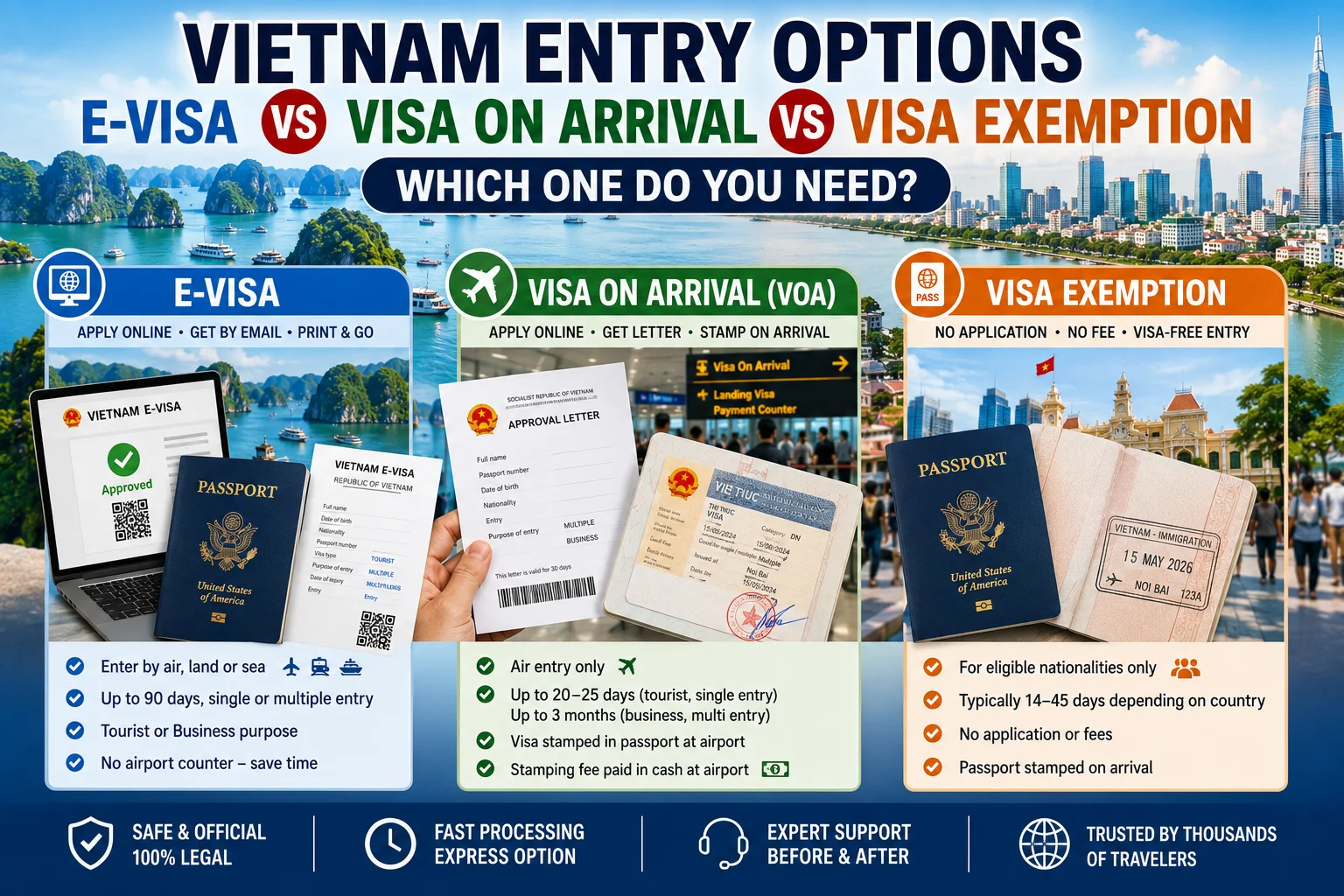
- Vietnam E-Visa — a fully online electronic visa. Apply from anywhere, get approved by email, print it, and travel. No airport counter step required.
- Vietnam Visa On Arrival (VOA) — apply online in advance for an approval letter, then get your visa physically stamped in your passport at a Vietnamese international airport when you land.
- Vietnam Visa Exemption — certain nationalities can enter Vietnam visa-free for a limited stay (commonly 14–45 days depending on the country), with no application needed at all.
None of these is universally “better” — the right choice depends on your nationality, how you’re travelling into the country, and how much time you have before departure.
Vietnam E-Visa: Quick Recap
The Vietnam e-visa is Vietnam’s fully electronic entry permit, open to citizens of essentially all countries and territories. It’s applied for entirely online, delivered as a PDF by email, and accepted at dozens of international airports, land borders, and seaports — making it the only one of the three options that works if you’re entering by land or by sea, not just by air.
Vietnam Visa On Arrival: Quick Recap
Vietnam Visa On Arrival also starts with an online application, but instead of a printable e-visa, you receive an approval letter, then get your actual visa stamped into your passport at the airport immigration counter when you land. It’s only available for travelers arriving by air — if you’re crossing a land border or arriving by cruise ship, VOA isn’t an option.
Vietnam Visa Exemption: What It Actually Means
Vietnam grants unilateral visa exemption to a defined list of nationalities, allowing visa-free entry for a set number of days (commonly ranging from 14 to 45 days depending on the country, and subject to change by government decision). If you’re exempt:
- You don’t need to apply for anything before you fly
- You don’t pay any visa fee
- Your passport is simply stamped at immigration on arrival, based on your nationality
The catch: exemption only covers short stays, and it’s tied strictly to your passport’s nationality — it can’t be extended into a longer e-visa-style stay without a fresh application for one. If your trip runs longer than your exemption period, or you want the flexibility of a longer 90-day e-visa, you’ll need to apply for one of the other two options instead.
Side-by-Side Comparison
| Factor | E-Visa | Visa On Arrival (VOA) | Visa Exemption |
|---|---|---|---|
| Who’s eligible | Essentially all nationalities | Travelers not covered by exemption, arriving by air | Only specific listed nationalities |
| How you enter | By air, land, or sea | By air only | By any method, per normal entry rules |
| Application needed? | Yes, online in advance | Yes, online in advance (approval letter) | No — nothing to apply for |
| Where the visa itself is issued | Printed PDF, no airport step | Physically stamped at the airport counter | Stamped on arrival based on passport check |
| Validity (tourist purpose) | Up to 90 days, single or multiple entry | Up to 20–25 days (tourist), single entry, non-extendable | Typically 14–45 days depending on nationality |
| Validity (business purpose) | Up to 90 days, single or multiple entry | Up to 3 months, single or multiple entry, extendable once | Not applicable — exemption doesn’t cover business sponsorship |
| Cost | Government fee ($25/$50) + service fee | Service fee + stamping fee ($25/$50, cash at airport) | Free |
| Best for | Most travelers, all entry methods, straightforward planning | Air travelers who prefer a physical stamp, or need business-purpose flexibility | Short trips for eligible nationalities |
How to Decide: Real Travel Scenarios
“I’m not sure if my country needs a visa at all.” Check whether your nationality is on Vietnam’s current visa exemption list before applying for anything. If you are exempt and your trip fits within the allowed number of days, you may not need to apply for either an e-visa or VOA.
“My country is visa-exempt, but I’m staying longer than the exemption allows.” You’ll need to apply for either an e-visa or VOA to cover the full length of your stay — exemption can’t simply be extended at the border.
“I’m arriving by land from Cambodia or Laos.” VOA isn’t an option for land border crossings. If you’re not exempt, the e-visa is your only online option — apply before you travel.
“I want to avoid standing in an airport queue for a visa stamp.” The e-visa is the better fit — you arrive with your visa already printed and ready, with no counter step required beyond normal immigration checks.
“I need a business visa with multiple entries over several months, longer than the e-visa allows.” Business VOA allows up to 3 months and can be extended once, provided you have a sponsoring company in Vietnam — a genuine advantage over the e-visa’s fixed 90-day cap for travelers who need it.
“I’m applying last-minute and my flight is in 2 days.” Both e-visa and VOA offer expedited processing tiers for urgent situations — an e-visa is generally simpler to arrange quickly since it doesn’t require airport-side documents like passport photos and cash on hand.
“I like having a physical visa stamp in my passport, not just a printed PDF.” VOA gives you that physical stamp. Some travelers simply prefer this for peace of mind or for record-keeping across multiple trips.
A Quick Word on Cost
It’s a common misconception that visa exemption is always the “best deal” and paid visas are something to avoid — but cost isn’t really the deciding factor here. Exemption is free because it doesn’t apply broadly or for long stays; e-visa and VOA both involve modest government fees precisely because they extend eligibility to essentially any nationality and, for the e-visa, any entry method. Choosing based on what your situation actually requires — nationality, trip length, and how you’re entering the country — will always serve you better than optimizing for the cheapest option first.
Frequently Asked Questions
1. What’s the main difference between e-visa and visa on arrival? The e-visa is a fully online electronic visa with no airport counter step, while VOA requires an approval letter followed by a physical stamp at the airport. E-visa also works for land and sea entry; VOA is air-only.
2. How do I know if my nationality qualifies for visa exemption? Vietnam maintains a specific list of exempt nationalities and allowed stay lengths, which can change by government decision — check current status before assuming you’re exempt.
3. Can I use visa exemption and then apply for an e-visa to extend my stay? No — exemption and e-visa are separate processes. If you need longer than your exemption period allows, apply for an e-visa (or VOA) in advance rather than assuming you can extend at the border.
4. Is visa on arrival available for land border crossings? No. VOA is only available for travelers arriving by air. Land border and cruise arrivals need a different visa arranged in advance, such as an e-visa.
5. Which option is faster to arrange in an emergency? Both offer expedited tiers, but the e-visa is generally simpler for last-minute situations since it doesn’t depend on airport-side steps like a stamping fee paid in cash.
6. Which is cheaper, e-visa or VOA? E-visa pricing is fixed and published upfront. VOA service fees vary by purpose, entry count, and processing speed, plus a separate cash stamping fee paid at the airport — get a quote before comparing directly.
7. Can business travelers use either e-visa or VOA? Yes, both support business purpose entry. VOA’s business category allows a longer validity (up to 3 months, extendable once) but requires a Vietnam-based sponsoring company, which the e-visa’s business purpose does not.
8. What if I’m not sure which option is right for my trip? Message a visa specialist with your nationality, entry method, and trip length — this is usually enough to confirm the right option in a single conversation.
Still Not Sure Which Entry Option Fits You?
Nationality, entry method, and trip length all affect which option makes sense — and getting it wrong can mean unnecessary cost or last-minute stress. Send us your travel details and we’ll confirm the right path before you apply for anything.
👉 Message us on WhatsApp or by email
Ready to apply? Visit our Vietnam E-Visa or Vietnam Visa On Arrival page to get started.
This article is for general informational purposes and reflects publicly available guidance current at the time of writing. Visa exemption lists, fees, and entry requirements are set by the Vietnam Immigration Department and may change; always confirm current details before travelling.
