
Do UK Citizens Need a Visa for Vietnam?
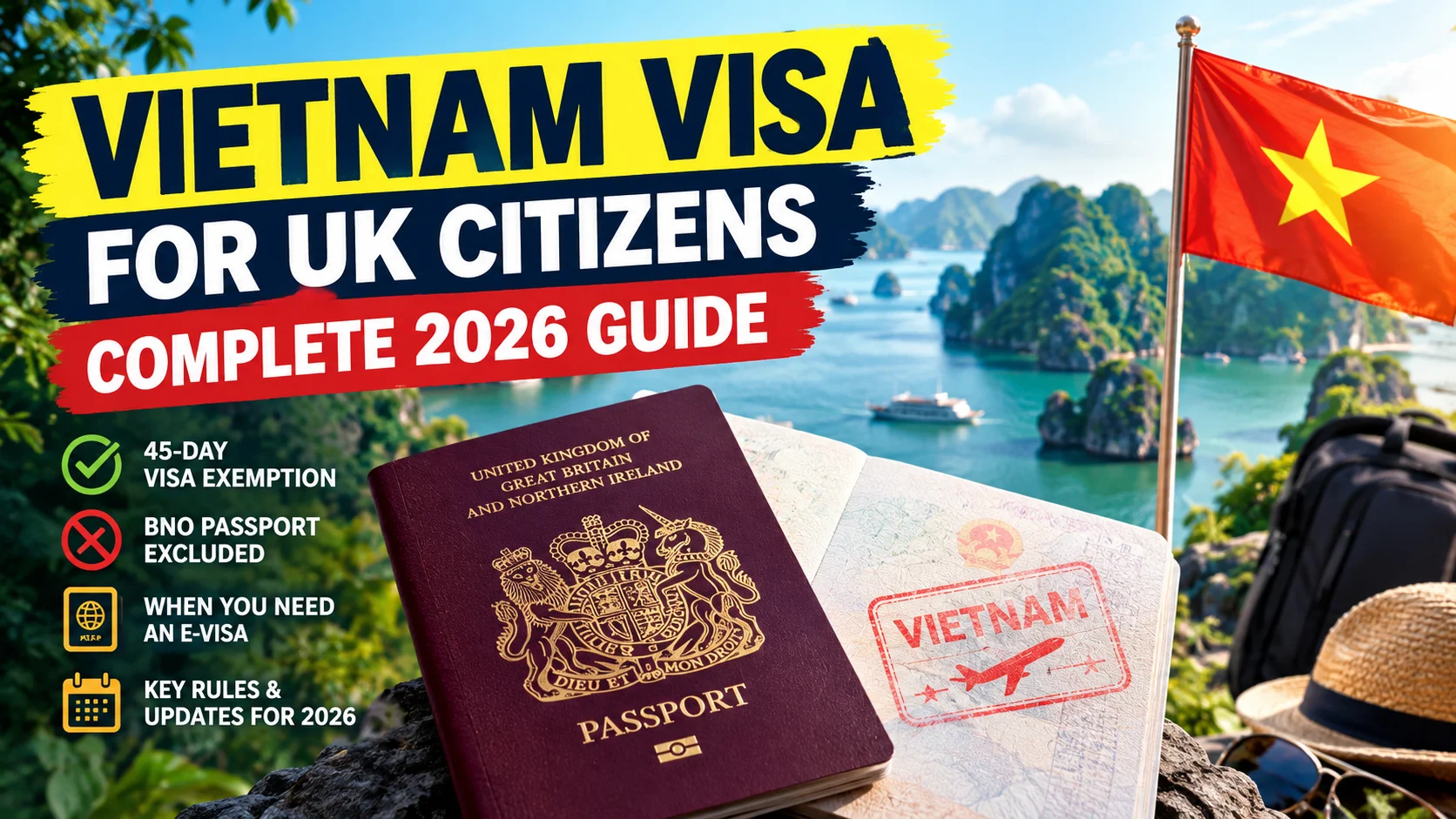
For most trips, no. UK passport holders can enter Vietnam visa-free for stays of up to 45 days, for tourism or short business purposes, with no application and no fee. This makes the UK one of the more favorably treated nationalities travelling to Vietnam — a meaningfully longer exemption than many other countries receive.
That said, “most trips” isn’t “every trip.” This guide covers exactly what the exemption includes, one important passport-type exclusion that catches some British travelers off guard, and what to do if your trip falls outside it.
The 45-Day Exemption, in Detail
UK citizens are exempt under Resolution 44/NQ-CP, currently in effect from 15 March 2025 through 14 March 2028. The key conditions:
| Condition | Details |
|---|---|
| Maximum stay | 45 days, counted from your date of entry |
| Purpose | Tourism or short-term business activities |
| Cost | Free — no application, no fee |
| Entry method | Applies at all entry points — air, land, and sea |
| Where you fly from | Doesn’t matter — you don’t need to fly directly from the UK to qualify |
| Passport validity | At least 6 months beyond your entry date |
| Blank pages | At least 2 blank pages required |
A detail worth knowing: you don’t need to depart from the UK for this exemption to apply. If you’re a British passport holder living in Australia, or connecting through a third country, the exemption still covers you — it’s tied to your passport, not your departure point.
The Important Exception: BNO Passport Holders
This is the detail most UK-focused guides mention briefly, if at all, and it’s worth calling out clearly: British National (Overseas) passport holders are not covered by the 45-day exemption. If you hold a BNO passport rather than a full British citizen passport, you need to apply for a Vietnam e-visa regardless of how short your trip is — the visa-free allowance simply doesn’t apply to this passport type.
If you’re unsure which passport category you hold, check the passport type printed on your document itself before assuming the exemption covers you — this is a genuinely easy detail to overlook, particularly for travelers who haven’t needed to think about the distinction before.
When UK Citizens Still Need a Visa
Beyond the BNO exception, a few other situations take you outside the free exemption:
- Staying longer than 45 days in a single visit
- Wanting a formal, stamped document for other purposes, even for a short trip
- Employment, long-term study, investment, or journalism activities — the exemption explicitly excludes these; it covers tourism and short business only
- Frequent, closely-spaced re-entries that could draw scrutiny as an attempt to substitute repeated exemption stays for what should genuinely be a long-stay visa
In any of these cases, the Vietnam e-visa is the straightforward next step — up to 90 days, single or multiple entry, and open to UK passport holders the same as any other nationality.
Outdated Information Still Floating Around
If your research turns up mentions of a 15-day exemption for UK citizens, that’s outdated — the previous 15-day allowance was abolished and replaced with the current 45-day policy. Some older forum posts and un-updated guides still reference the old figure, so if you see “15 days” cited anywhere, treat it as stale information rather than current policy.
Doing a “Visa Run” to Reset Your 45 Days
If your trip runs close to (or you’d like to extend past) 45 days, one option UK travelers commonly use is exiting Vietnam briefly — a short flight to Bangkok, or a bus across the border to Cambodia — and re-entering for a fresh 45-day exemption period. As of current policy, there’s no mandatory cooling-off period between visa-free entries for UK citizens. That said, immigration authorities retain discretion to question a pattern of very frequent re-entries that looks like it’s designed specifically to avoid ever applying for a proper visa — an occasional border hop for a genuine reason is a different situation from a repeated, deliberate cycle.
The exemption itself cannot be extended from inside Vietnam — if you want more time, your only options are leaving and re-entering for a new 45-day period, or applying for a 90-day e-visa before your original exemption runs out.
Exemption vs. E-Visa: Which Should You Choose?
| 45-Day Exemption | Vietnam E-Visa | |
|---|---|---|
| Cost | Free | $25 single entry / $50 multiple entry government fee |
| Maximum stay | 45 days | Up to 90 days |
| Application needed | No | Yes, online in advance |
| Covers BNO passports | No | Yes |
| Entry/exit flexibility | Multiple entry via re-exemption (no formal multiple-entry document) | True multiple entry within one visa if selected |
| Best for | Most standard UK holidays and short business trips | Longer stays, BNO passport holders, or wanting a stamped document in hand before flying |
For the average two-to-four week UK holiday, the exemption is simply the easier option — nothing to apply for, nothing to pay. The e-visa becomes the better choice once your plans exceed 45 days, or don’t fit the tourism/short-business framing the exemption is built for.
Common Mistakes UK Travelers Make
Assuming the 45-day exemption applies to BNO passports. This is the single most consequential mistake covered in this guide — BNO holders who assume they’re covered by the standard UK exemption can find themselves without valid entry documentation.
Citing outdated 15-day information. As covered above, this figure is stale — always confirm you’re looking at current 2026 guidance rather than an old forum thread or un-updated blog post.
Assuming a flight must originate in the UK. Some travelers mistakenly believe the exemption only applies when flying directly from Britain — it doesn’t; the exemption is tied to your passport, not your departure city.
Miscounting the 45 days. The count starts from your actual entry date, not your booking date or the date you arrive at your accommodation — a small mental slip that’s easy to make on a longer, multi-stop Southeast Asia itinerary.
Not realizing work is excluded, even informally. Some UK travelers assume “just a bit of remote work” during a visa-free holiday is fine because they’re not employed by a Vietnamese company — the exemption’s tourism/short-business framing is narrower than that assumption in practice; see our guide on Vietnam visas for digital nomads if this applies to your situation, since the same underlying legal restriction on labour activities applies whether you’re on the free exemption or a tourist e-visa.
A Worked Scenario: Planning a Trip From the UK
To make this concrete, consider a traveler in Manchester planning a 5-week trip through Vietnam, connecting through Singapore:
- Confirm passport validity — at least 6 months beyond the planned exit date, with 2 blank pages
- Check the trip length against 45 days — a 5-week (35-day) trip fits comfortably within the exemption, so no application is needed
- Don’t worry about the Singapore connection — since the exemption isn’t tied to flying directly from the UK, connecting through a third country doesn’t affect eligibility
- Confirm the passport type is a standard British citizen passport, not BNO — this is the detail most worth double-checking before assuming the trip needs nothing at all
- If plans later extend past 45 days, switch to planning for a Vietnam e-visa instead, applied before departure
This scenario illustrates why the UK situation is genuinely simpler than nationalities requiring a visa for every trip — but also why the BNO exception and the 45-day count are worth confirming rather than assuming.
How the UK Compares to Other Exempt European Nationalities
UK citizens share the 45-day exemption tier with a substantial group of other nationalities, including France, Germany, Italy, Spain, and several others under the same Resolution 44/NQ-CP and its later expansion. This puts British travelers in a notably better position than nationalities like the US, Canada, or Australia, who have no exemption at all and need an e-visa for every trip regardless of length. It’s worth knowing this if you’re travelling as part of a mixed-nationality group — a common source of confusion when, say, a British traveler and an American traveler assume the same rules apply to both, when in fact one needs nothing and the other needs a full e-visa application. See our full breakdown in Vietnam Visa Requirements by Nationality if your travel group includes multiple passport types.
Frequently Asked Questions
1. Do UK citizens need a visa to visit Vietnam? Not for trips of 45 days or less, for tourism or short business — this covers most UK travelers. Longer stays, BNO passport holders, or other purposes need an e-visa.
2. Does the 45-day exemption apply to BNO passport holders? No. BNO passport holders need to apply for a Vietnam e-visa regardless of trip length — the standard UK exemption doesn’t cover this passport type.
3. Do I need to fly directly from the UK to qualify for the exemption? No. The exemption is tied to your UK passport, not your departure point — you can connect through any country and still qualify.
4. Can I do a visa run to extend my stay past 45 days? Yes — exiting and re-entering Vietnam resets your exemption period, and there’s currently no mandatory waiting period between visa-free entries for UK citizens.
5. Is the old 15-day exemption still accurate? No. That figure was abolished and replaced by the current 45-day exemption — if you see 15 days referenced, it’s outdated information.
6. Does the exemption cover business trips? Yes, for short-term business activities. Longer or more formal business arrangements, or anything involving employment, fall outside the exemption’s scope.
7. What if I want to stay longer than 45 days from the start? Apply for a Vietnam e-visa before you travel, which covers up to 90 days.
8. Can children travel under the same 45-day exemption? Yes, the exemption applies per passport, so a child holding their own UK passport is covered the same way as an adult.
9. Does the exemption apply at land border crossings, not just airports? Yes — the exemption applies at all entry points, including air, land, and sea.
10. What’s the fastest way to get a Vietnam visa if I need one urgently? See our Urgent Vietnam Visa service if your trip falls outside the exemption and your departure is close.
11. If I’m travelling with a mix of UK and non-exempt nationalities, do we all follow the same rule? No. Each traveler’s requirement depends on their own passport nationality — a UK citizen in the group may need nothing at all, while a US or Australian citizen in the same group needs a full e-visa application.
12. Can I use the 45-day exemption more than once in the same year? Yes, in principle — there’s currently no mandatory cooling-off period or annual limit stated for UK citizens, though immigration authorities retain discretion over patterns that look designed to avoid a proper visa.
Planning a Trip Longer Than 45 Days, or Travelling on a BNO Passport?
If your trip doesn’t fit the free exemption, we’ll get your e-visa sorted quickly and correctly.
👉 Message us on WhatsApp or by email
Ready to apply? Start with our Vietnam E-Visa page. Want the full picture across nationalities? See Vietnam Visa Requirements by Nationality.
This article is for general informational purposes and reflects publicly available guidance current at the time of writing. Visa exemption policies and fees are set by the Vietnam Immigration Department and can change; always confirm current details before booking travel.
