
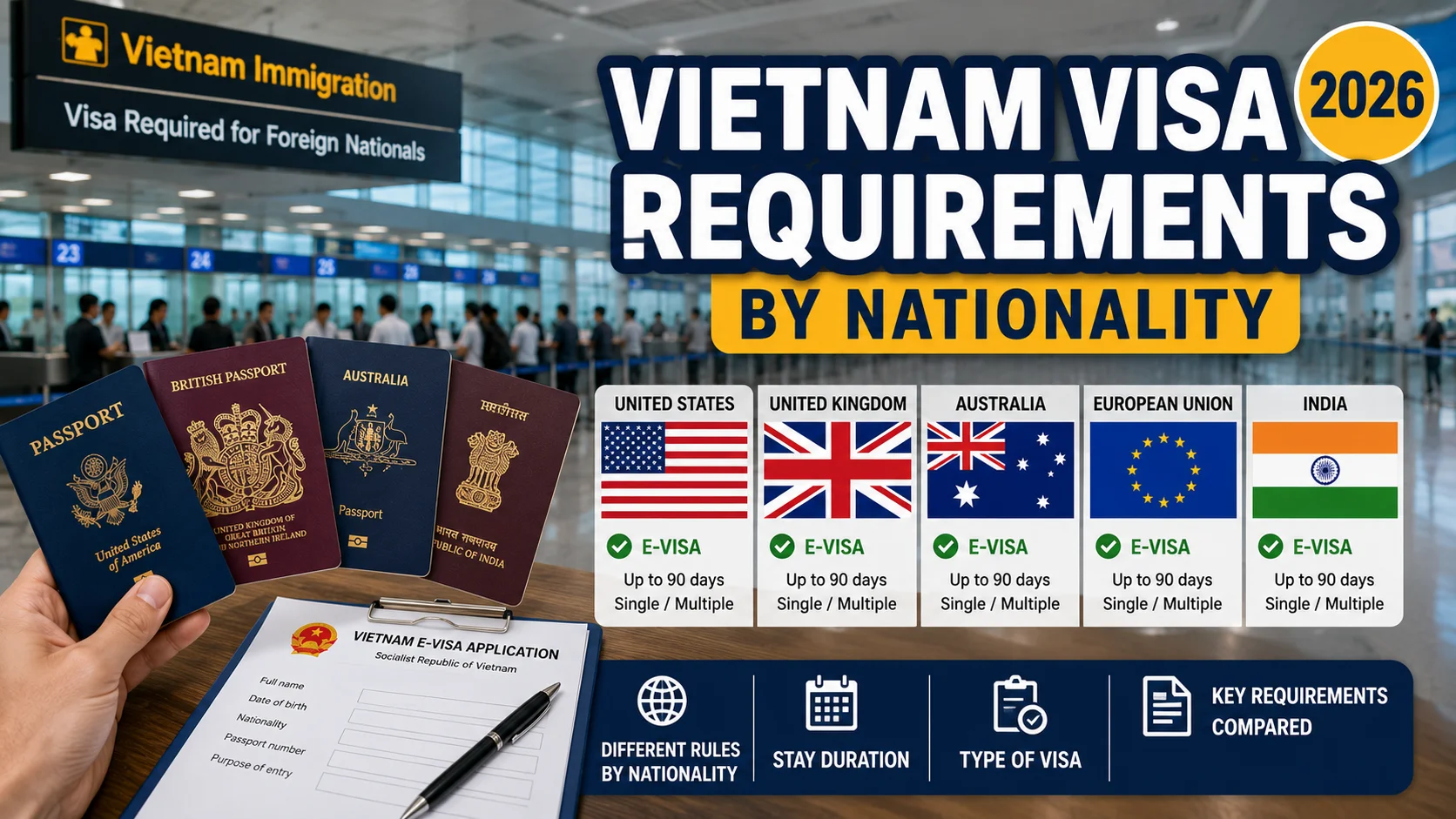
“Do I need a visa for Vietnam?” has a different answer depending entirely on which passport you’re holding. Some nationalities walk in visa-free for over a month; others need to apply for an e-visa for every single trip, regardless of how short the visit is. This guide gives a direct answer for five of the most common nationality groups researching Vietnam travel — the United States, United Kingdom, Australia, the European Union, and India — with the specific requirements, quirks, and common mistakes for each.
The Quick Answer, by Nationality
| Nationality | Visa-Free? | Max Stay Without a Visa | What You Need Otherwise |
|---|---|---|---|
| 🇺🇸 United States | No | — | Vietnam e-visa, every trip |
| 🇬🇧 United Kingdom | Yes | 45 days | E-visa only if staying longer or for other purposes |
| 🇦🇺 Australia | No | — | Vietnam e-visa, every trip |
| 🇪🇺 European Union | Mixed | 45 days (18 of 27 member states) | E-visa required for the other 9 member states |
| 🇮🇳 India | No | — | Vietnam e-visa, every trip |
United States: E-Visa Required for Every Trip
The US is not on Vietnam’s visa exemption list, and there’s no unilateral or reciprocal exemption arrangement between the two countries. Every US passport holder needs a valid entry document for every visit to mainland Vietnam, regardless of trip length or purpose.
What applies to you:
- Apply for the Vietnam e-visa — valid up to 90 days, single or multiple entry, accepted at all 83 ports of entry
- Government fee: $25 USD (single entry) or $50 USD (multiple entry)
- Holding a valid US visa for another country has no bearing on Vietnam’s requirement — a common misconception among first-time travelers used to visa-free access to many other destinations
One exception worth knowing: Phu Quoc Island grants visa-free entry to any nationality, including US citizens, for stays up to 30 days on a direct international arrival. This only covers the island itself — travelling onward to the mainland during the same trip requires a valid e-visa for that portion.
United Kingdom: Visa-Free for Most Trips
UK passport holders are among the longest-standing exempt nationalities, currently allowed 45 days visa-free, multiple entry. For the majority of holiday and short business trips, this means no application, no fee, and no waiting — just a passport meeting standard entry conditions.
When UK travelers still need a visa:
- Staying longer than 45 days in a single visit
- Wanting a formal, stamped document (some travelers prefer this for peace of mind or as proof for other purposes)
- Frequent, closely-spaced short trips that could draw scrutiny as an attempt to substitute repeated exemption stays for a genuine long-stay visa
In these cases, the Vietnam e-visa covers up to 90 days and is the straightforward next step.
Australia: E-Visa Required for Every Trip
Like the US, Australia is not on Vietnam’s exemption list. Australian citizens need an e-visa for every mainland trip, regardless of stay length.
What applies to you:
- Apply for the Vietnam e-visa before departure — it cannot be arranged on arrival without a pre-approved document
- Same $25/$50 USD government fee structure as other non-exempt nationalities
- The same Phu Quoc Island exception applies: visa-free for up to 30 days if that’s your sole Vietnamese destination
European Union: A Genuinely Mixed Picture
This is where “EU citizens” as a single group breaks down — exemption is granted country by country, not by EU membership. Under Vietnam’s current framework (Resolution 44/NQ-CP, effective March 2025, and Resolution 229/NQ-CP, effective August 2025), 18 of the EU’s 27 member states are on the 45-day exemption list, while the remaining 9 are not.
Exempt EU member states (45 days, multiple entry): Belgium, Bulgaria, Croatia, Czechia, Denmark, Finland, France, Germany, Hungary, Italy, Luxembourg, Netherlands, Poland, Romania, Slovakia, Slovenia, Spain, Sweden
EU member states NOT currently exempt: Austria, Cyprus, Estonia, Greece, Ireland, Latvia, Lithuania, Malta, Portugal
If your EU country isn’t on the exempt list, or your trip exceeds 45 days, the Vietnam e-visa applies the same way it does for the US or Australia.
A common mistake worth flagging: don’t assume exemption based on Schengen Area membership or general “being European.” Several Schengen countries — Portugal and Ireland among them — are not currently exempt, while non-EU European countries like the UK, Switzerland, and Norway are. Check your specific nationality rather than your region.
India: E-Visa Required for Every Trip
India is not currently on Vietnam’s exemption list, and Indian citizens need a valid visa — most commonly the e-visa — for every trip to mainland Vietnam.
What applies to you:
- Apply for the Vietnam e-visa — valid up to 90 days, same $25/$50 USD fee structure
- A specific, common issue: Indian applicants sometimes have payment rejected by the government portal when using certain Indian-issued cards. If this happens, trying a different card that clearly supports international online transactions, or applying through a service that handles payment on your behalf, usually resolves it
- Photo sizing confusion: Vietnam’s e-visa photo requirement (4×6 cm) differs from the standard Indian passport photo size (2×2 inches) — resizing an existing passport photo instead of taking a correctly-sized new one is a common, avoidable error
Overseas Indians of Vietnamese origin: if you or a family member holds Vietnamese heritage, a separate 5-year visa exemption certificate may apply through a Vietnamese embassy or consulate — this is different from the standard e-visa route and worth asking about directly if it might apply to your family.
Real Scenarios: How This Plays Out in Practice
“I’m a UK citizen planning a 10-day holiday.” No visa needed at all — arrive with your passport meeting the standard 6-month validity rule, and you’re stamped in for up to 45 days.
“I’m American, and my trip is only 5 days for a work conference.” Trip length doesn’t matter here — since the US isn’t exempt, even a very short visit requires an e-visa with the Business Activities purpose selected in advance.
“I’m German, and I’m combining Vietnam with a longer Southeast Asia trip lasting 60 days total, with only 20 of those days in Vietnam.” Since Germany is on the 45-day exempt list, and your actual time in Vietnam is under that limit, you likely don’t need to apply for anything — just make sure your total consecutive stay in Vietnam itself doesn’t exceed 45 days.
“I’m Irish, and I assumed being in the EU meant I was covered.” This is one of the most common assumptions that turns out to be incorrect — Ireland is not currently on Vietnam’s exemption list, so an e-visa is required regardless of EU membership.
“I’m Indian, travelling with my Australian husband.” Both of you need your own individual e-visa applications, since neither India nor Australia is exempt — there’s no combined family application, and this holds even if you’re travelling on the same itinerary.
“I’m from Portugal, and my Spanish friend says she doesn’t need a visa — do I?” This is exactly the kind of mixed-group confusion that trips people up. Spain is on the 45-day exempt list; Portugal currently is not. Two EU citizens, two different answers, on the same trip.
Traveling in a Mixed-Nationality Group
It’s increasingly common for travel groups — families, couples, or friends — to hold different passports, and this guide’s biggest practical takeaway for mixed groups is simple: check each passport individually, not the group as a whole. A group of four travelers could easily include one exempt nationality, two requiring an e-visa, and one needing to double-check a specific EU member state’s status — all on the identical itinerary. Assuming everyone falls under the same rule because you’re travelling together is one of the most avoidable planning mistakes across all five nationality groups covered here.
What All Five Groups Have in Common
Regardless of nationality, a few things apply universally once you’re applying for the e-visa:
- Passport validity: at least 6 months beyond your planned exit date
- Entry points: the e-visa is valid at all 83 ports of entry — 17 airports, 27 land borders, and 39 seaports
- Purpose of entry: select the category that genuinely matches your trip — see our guide on Tourist vs Business Visa if you’re unsure which applies
- Overstay penalties: fines apply for any stay beyond your visa or exemption period, scaling with the length of the overstay — from roughly $19–76 USD for 1–15 days over, up to significantly more for longer overstays, plus a possible re-entry ban
- Single vs. multiple entry: if you’re planning to leave Vietnam and return within the same trip — for a side trip to Cambodia or Laos, for example — a multiple-entry e-visa is worth choosing upfront, since switching from single to multiple entry after approval isn’t possible; this applies to all non-exempt nationalities equally, regardless of which of the five groups above you fall into
Frequently Asked Questions
1. Do US citizens need a visa for Vietnam? Yes, for every trip to mainland Vietnam — the US is not on the exemption list. Phu Quoc Island is a visa-free exception if it’s your only destination.
2. How long can UK citizens stay in Vietnam without a visa? Up to 45 days, multiple entry, with no application or fee required.
3. Are all EU citizens exempt from a Vietnam visa? No — exemption is granted country by country. Currently 18 of 27 EU member states qualify for 45 days visa-free; the other 9 need an e-visa.
4. Do Australians need a visa for Vietnam? Yes, for every trip — Australia is not on the exemption list, so an e-visa is required regardless of stay length.
5. Can Indian citizens get visa-free entry to Vietnam? No, not currently. Indian passport holders need a valid visa, most commonly the e-visa, for every trip to mainland Vietnam.
6. Why does my Indian card get rejected on the e-visa payment page? Some Indian-issued cards aren’t accepted by the government portal for international payment. Trying a different card that supports international transactions, or applying through a service that manages payment, generally resolves this.
7. Is Portugal or Ireland exempt, since they’re in the EU? No — both are current examples of EU member states not on Vietnam’s exemption list, despite common assumptions based on regional membership.
8. What happens if I stay longer than my exemption or visa allows? Overstay fines apply, scaling with how long you’ve overstayed, along with a possible ban on re-entry — there’s no grace period.
9. Does holding a US, UK, or Australian visa help my Vietnam application? No. Vietnam’s visa and exemption decisions are based solely on your passport’s nationality, not on visas or exemptions you hold for other countries.
10. Where can I check if my specific country’s status has changed? Exemption lists are set by Vietnamese government decision and can be updated over time — check the official portal at evisa.gov.vn, or message a specialist to confirm current status for your nationality.
Ready to Apply for Your Vietnam Visa?
Whichever passport you’re holding, we can confirm exactly what you need and handle the application for you.
👉 Message us on WhatsApp or by email
Ready to apply? Start with our Vietnam E-Visa page. Want the full exemption list for all 39 eligible countries? See Vietnam Visa Exemption 2026.
This article is for general informational purposes and reflects publicly available guidance current at the time of writing, cross-checked across multiple sources for accuracy. Visa exemption lists, fees, and requirements are set by the Vietnam Immigration Department and can change; always confirm current details for your specific nationality before booking travel.
