
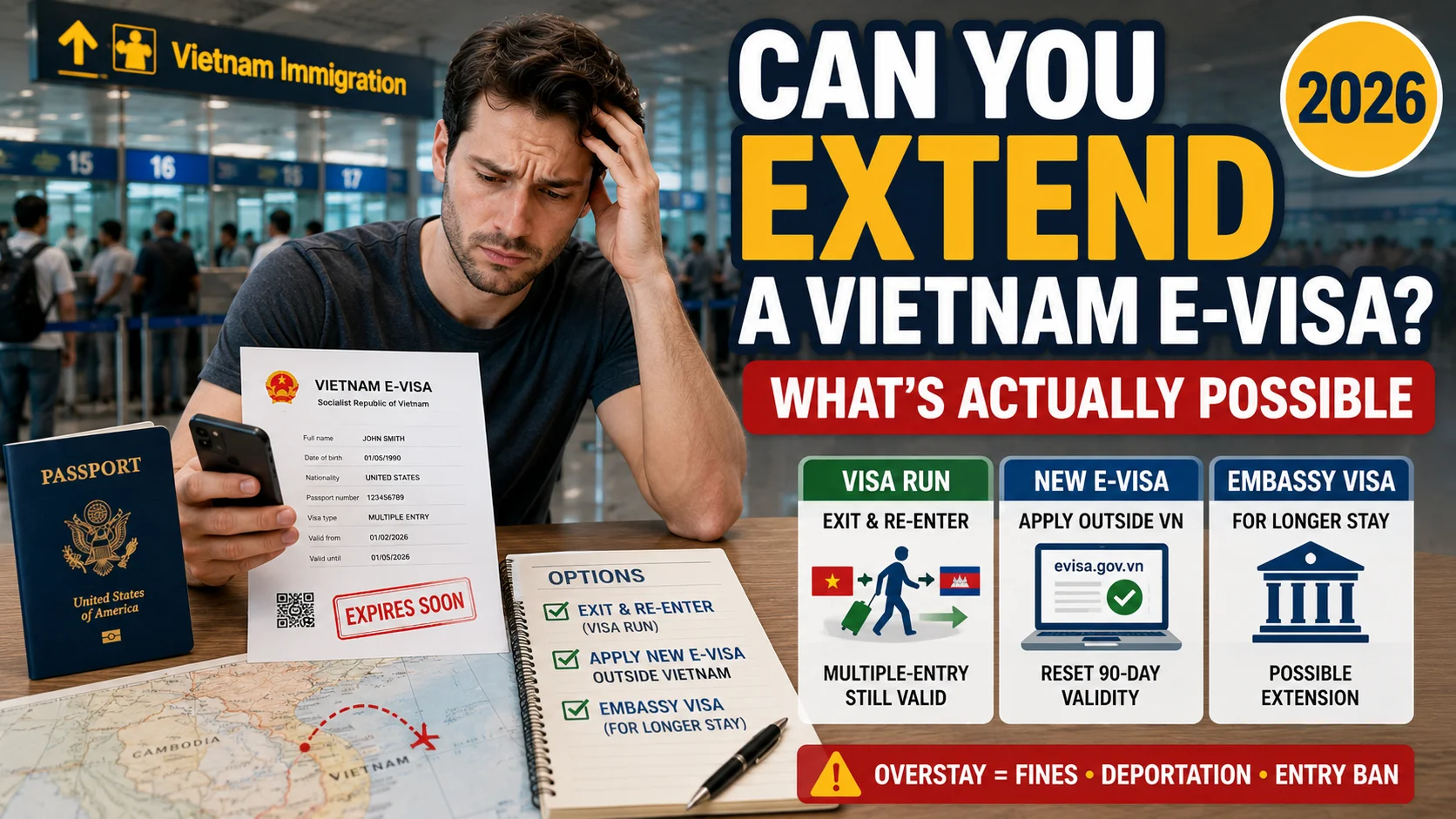
The Direct Answer
No — a Vietnam e-visa cannot be extended or renewed from inside the country. The e-visa is issued as a fixed-validity electronic entry permit, with a start and end date locked in at the time of application. There is currently no in-country process to extend it, regardless of your purpose of entry (Tourism or Business) or whether you hold a single or multiple-entry version.
If you’re reading this because your e-visa is running out and you’re not ready to leave Vietnam, this guide covers exactly what your real options are — and the penalties worth avoiding if you let the date pass without acting.
Why the E-Visa Specifically Can’t Be Extended
It helps to understand what makes the e-visa different from Vietnam’s other visa categories. The e-visa is a single-issue, government-processed electronic document — once approved, its validity window is fixed, and there’s no administrative mechanism to modify it after the fact, the way there is for some traditional visa categories.
This is different from traditional embassy-issued sticker visas (the older DN/DL categories, applied for through a Vietnamese embassy or consulate). Some of these can be extended by 1 additional month through Vietnam’s immigration department, provided the original visa was a 1-month or 3-month single or multiple-entry category. If you’re holding one of these traditional visas rather than an e-visa, an in-country extension may genuinely be possible — but that’s a separate process, handled by Vietnam’s immigration authorities directly, not the e-visa system.
The distinction matters: if you applied through the e-visa portal (evisa.gov.vn) — which is what the large majority of tourists and business travelers use today — extension is not an option, full stop.
Your Real Options If You Need More Time
Option 1: Exit and Re-Enter (“Visa Run”)
The most common solution is simply leaving Vietnam and coming back. If you hold a multiple-entry e-visa that’s still within its validity window, you can exit to a neighboring country (Cambodia, Laos, or elsewhere) and re-enter without applying for anything new, as long as you’re still inside your original 90-day window.
If your e-visa has fully expired, or you only hold a single-entry version, you’ll need to apply for a brand-new e-visa before re-entering — this can be done from outside Vietnam, and if you’re short on time, an urgent processing tier can have a new e-visa approved in as little as 1 working hour under the right conditions.
Option 2: Apply for a New E-Visa From Outside Vietnam
If you’re already planning to leave (rather than doing a quick border run), simply exiting and applying for a fresh Vietnam e-visa from outside the country resets your full 90-day window. This is often the cleanest option if your travel plans have genuinely grown beyond your original visa.
Option 3: Consider a Traditional Embassy Visa for Future Trips
If you already know a future trip will need more flexibility than a 90-day e-visa allows — a longer project, an extended stay, or genuine uncertainty about your return date — applying through a Vietnamese embassy for a traditional visa category (rather than the e-visa) may be worth exploring for that specific trip, since some of those categories do support in-country extension. This is a different process from our e-visa service and worth discussing directly with a specialist if your situation looks like it might call for it.
Avoiding the Problem From the Start
The cleanest way to sidestep this entire issue is choosing the right e-visa type before you ever arrive:
- If there’s any chance you’ll want to leave and re-enter Vietnam during your trip — for a side trip to Cambodia or Laos, for example — apply for the multiple-entry e-visa upfront. Switching from single to multiple entry after approval isn’t possible.
- If your plans are genuinely open-ended or likely to extend well beyond 90 days, it’s worth having the embassy-visa conversation before you travel, rather than discovering the limitation once you’re already in the country.
What Happens If You Overstay Instead
If your e-visa expires and you haven’t left, this is treated as an immigration violation, with real consequences that have gotten more clearly defined recently:
Financial penalties (Decree 282/2025, effective 15 December 2025): fines scale with how long you’ve overstayed — smaller violations of a few days carry a modest fine, while longer overstays escalate significantly. The general principle across similar frameworks: the sooner you address an overstay, the smaller the penalty.
Deportation risk (Decree 59/2026, effective 1 April 2026): overstays of 16 days or more can result in deportation, not just a fine.
Blacklisting and re-entry bans: severe or repeated violations can lead to being blacklisted, with a multi-year ban on returning to Vietnam — a consequence that outlasts the cost of any visa run or new application by a wide margin.
There’s no grace period built into any of this — the moment your e-visa’s exit date passes without you having left, the overstay clock is already running.
Weighing the Cost: Visa Run vs. Overstay
It’s worth doing the math plainly, since the two paths lead to very different outcomes:
| Visa Run / New E-Visa | Overstaying Instead | |
|---|---|---|
| Cost | Government fee ($25–$50) plus any service fee, plus travel cost to/from a border | Escalating fines, potentially deportation costs |
| Time | A few hours to a few days, depending on processing tier | Delays resolving your situation, possible detention during processing |
| Future travel impact | None | Possible blacklisting and multi-year re-entry ban for serious cases |
| Predictability | Fully within your control | Depends on how immigration authorities handle your specific case |
Framed this way, even an inconvenient last-minute visa run is almost always the better outcome compared to letting an e-visa lapse and hoping it goes unnoticed — Vietnam’s immigration system checks exit dates against your visa at departure, so an overstay doesn’t quietly resolve itself.
Who Actually Runs Into This Problem
A few traveler patterns account for most of the situations where this question comes up:
Travelers who underestimated their trip length. A planned 3-week holiday that organically grows into 6 weeks is one of the most common causes — enthusiasm for extending a trip outpaces the visa that was originally applied for.
Digital nomads and remote workers. Travelers working remotely for a company outside Vietnam sometimes settle into a longer stay than initially planned, without realizing their tourist or business e-visa was only ever valid for a fixed window.
Business travelers whose project timeline shifted. A project that was supposed to wrap in a month sometimes runs long, and the business e-visa doesn’t flex to match a shifted timeline.
Travelers who applied for single entry, then wanted to leave and return. This isn’t strictly an “extension” problem, but it produces the same frustration — a single-entry e-visa can’t be converted to multiple entry after the fact, so a spontaneous side trip to a neighboring country forces a fresh application rather than a quick re-entry.
Recognizing your own situation among these patterns is often the fastest way to figure out which of the three options above actually fits your case.
Common Scenarios
“My e-visa expires in 3 days and I want to stay another 2 weeks.” You’ll need to exit Vietnam and either re-enter under a still-valid multiple-entry e-visa (if applicable) or apply for a new one from outside the country — there’s no way to extend in place.
“I’m on a multiple-entry e-visa and I want to do a quick Cambodia trip and come back.” This is exactly what multiple-entry is designed for — as long as you’re still within your original 90-day window, you can exit and re-enter without a new application.
“I entered visa-free under my country’s exemption and want more time.” Exemption works the same way as the e-visa here — it cannot be extended in-country either. You’ll need to exit and re-enter under a fresh exemption period, or apply for a 90-day e-visa instead.
“I’m already 10 days past my e-visa’s exit date and just realized it.” Address this immediately — visiting a local immigration office or getting expert guidance on the correct exit process is far better than waiting, since penalties scale with time and 16+ days can introduce deportation risk.
“I have a genuine long-term project in Vietnam and know 90 days won’t be enough.” This is the scenario where planning ahead with a traditional embassy visa, rather than the e-visa, is worth exploring before you ever travel — message a specialist to talk through whether this fits your situation.
Frequently Asked Questions
1. Can I extend my Vietnam e-visa while I’m inside the country? No. The e-visa has a fixed validity period set at application, with no in-country extension process currently available.
2. What’s the difference between visa extension and visa renewal? Extension typically means adding time to your current visa via an official stamp; renewal means receiving an entirely new visa sticker with a new duration. Neither applies to the e-visa system — both concepts relate to traditional embassy-issued visas instead.
3. Can I do a visa run and come straight back? Yes, if you hold a valid multiple-entry e-visa still within its validity window. If your e-visa has expired or is single-entry, you’ll need a new application from outside Vietnam first.
4. What happens if I overstay by just a day or two? A financial penalty applies under current regulations, scaling with the length of the overstay — even a short overstay carries a fine, though the amount is smaller than longer violations.
5. Can visa-exempt travelers extend their stay in-country? No. Visa exemption cannot be extended from inside Vietnam either — the same exit-and-reapply principle applies.
6. Is there any way to avoid needing an extension in the first place? Yes — applying for a 90-day multiple-entry e-visa upfront, rather than single entry, gives you flexibility to exit and re-enter without needing anything extended.
7. What’s the risk if I overstay for more than 2 weeks? Under current regulations, overstays of 16 days or more can lead to deportation, in addition to financial penalties.
8. Can a traditional embassy visa be extended in-country? In some cases yes — certain traditional visa categories (1-month or 3-month, single or multiple entry) can be extended by an additional month through Vietnam’s immigration department, unlike the e-visa.
9. Will an immigration violation affect future trips to Vietnam? Severe or repeated violations can result in blacklisting and a multi-year ban on re-entry, which is a significantly more serious and lasting consequence than the cost of simply reapplying on time.
10. Who should I talk to if my situation is genuinely long-term or complicated? Message a visa specialist directly — situations involving long-term stays, project work, or uncertain return dates are exactly the kind of case worth discussing before you travel, rather than working around after the fact.
Planning a Trip That Might Need More Flexibility?
If there’s any chance you’ll need to leave and re-enter Vietnam, or your plans might stretch past 90 days, let’s get the right visa type sorted before you fly — it’s far simpler than solving it once you’re already in the country.
👉 Message us on WhatsApp or by email
Ready to apply? See our Vietnam E-Visa page — be sure to select multiple entry if there’s any chance you’ll need it. Flight coming up fast? See our Urgent Vietnam Visa service.
This article is for general informational purposes and reflects publicly available guidance current at the time of writing. Immigration regulations, penalties, and extension procedures are set by the Vietnam Immigration Department and can change; always confirm current details before relying on any of the above, especially if you are already approaching an overstay situation.
