
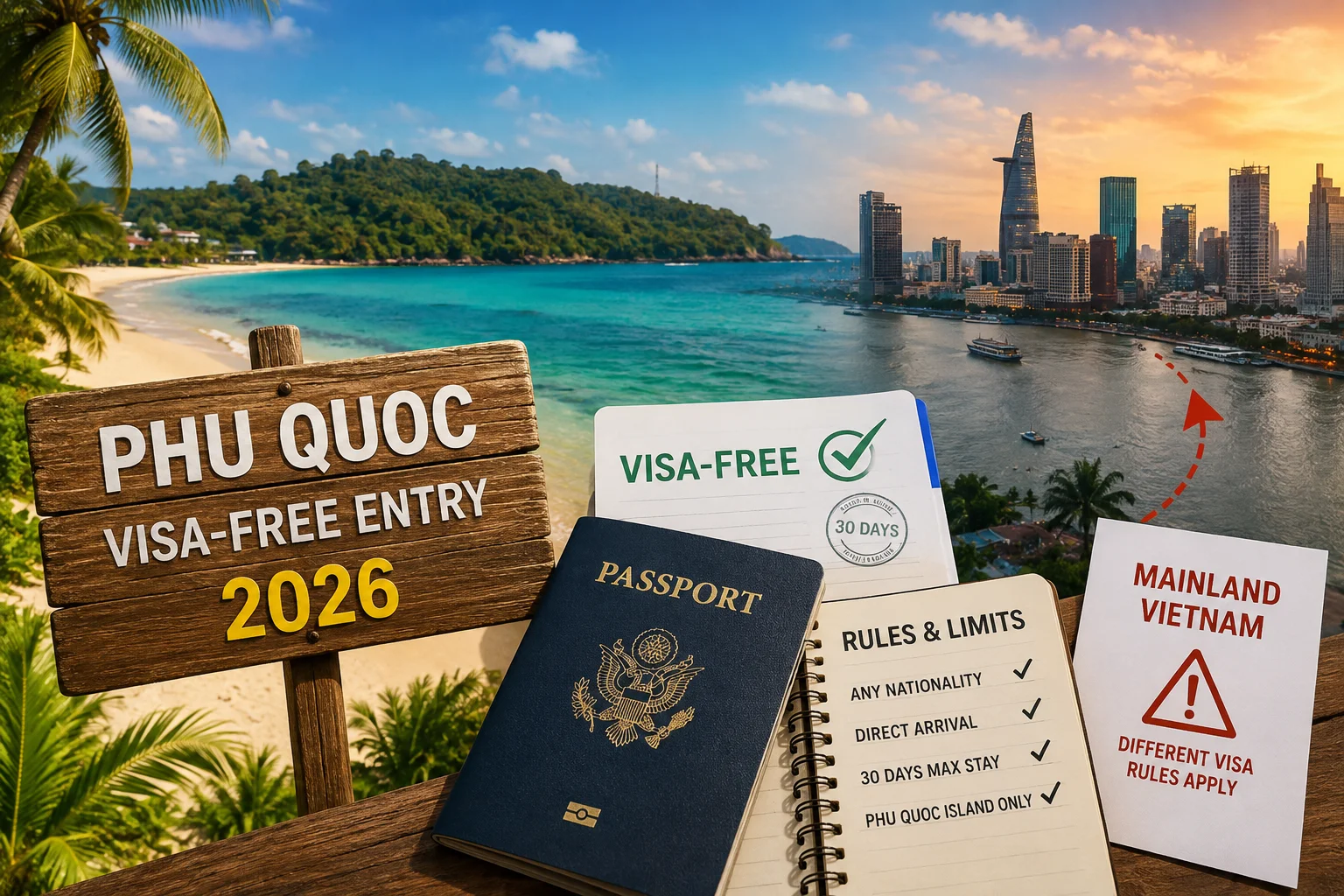
Vietnam’s One Universal Exception
Everywhere else in Vietnam, whether you need a visa depends entirely on your passport — some nationalities are exempt, most aren’t. Phu Quoc Island is the one exception to that rule. Under a dedicated government policy, travelers of any nationality can enter Phu Quoc visa-free for up to 30 days — the only place in the country where this applies without exception.
That said, “visa-free” here comes with specific conditions, and it’s easy to accidentally disqualify yourself without realizing it — especially if your trip includes the Vietnamese mainland too. This guide covers exactly what qualifies, what doesn’t, and what to do if Phu Quoc is only part of your itinerary.
The Legal Basis (And Why It’s Different From Everywhere Else)
Phu Quoc’s visa-free policy was established under Decision No. 80/2013/QĐ-TTg, signed by Vietnam’s Prime Minister on 27 December 2013 and in effect since 10 March 2014. It designates Phu Quoc as a special economic zone, and as part of that status, the government removed the visa requirement entirely for short-term visitors — regardless of nationality — as a tourism development measure. This is a fundamentally different mechanism from the standard Vietnam Visa Exemption list, which grants visa-free entry only to specific nationalities for the mainland. Phu Quoc’s policy exists entirely separately, and applies universally.
The Conditions, in Full
To qualify for Phu Quoc’s visa-free entry, you need to meet all of the following:
| Condition | Details |
|---|---|
| Direct international arrival | You must fly or sail directly to Phu Quoc from outside Vietnam — Phu Quoc International Airport (PQC) or an approved seaport |
| Maximum stay: 30 days | Counted from your entry date; even one day over counts as an overstay |
| Passport validity | Valid for at least 6 months from your entry date |
| Staying on the island | The exemption covers Phu Quoc only — travelling to the mainland during the same trip requires separate documentation |
| Departure within 30 days | Either onward to another country, or back home — not onward travel deeper into Vietnam without the right visa |
Who qualifies: literally any nationality, including US, Canadian, and Australian citizens — the three groups who are notably excluded from Vietnam’s standard mainland exemption list. This policy also covers Vietnamese citizens holding a foreign passport.
The Transit Exception (Read This Carefully)
A detail that trips up a lot of travelers: you don’t need a nonstop flight to qualify. If your itinerary connects through another Vietnamese international airport — Ho Chi Minh City or Hanoi, for example — on the way to Phu Quoc, you can still qualify for the exemption, provided you stay within the airport’s transit area and continue to Phu Quoc on the same day, without formally clearing immigration at that first stop.
The moment you clear immigration at an intermediate Vietnamese airport before continuing to Phu Quoc, you’re no longer making a “direct” arrival to the island under this policy — at that point, standard mainland visa requirements apply to your entire trip instead. If your itinerary involves any connection through Vietnam, it’s worth confirming the specific routing with your airline before assuming the exemption still applies.
What Happens If You Want to Visit the Mainland Too
This is the single most common point of confusion, so it’s worth stating plainly: the Phu Quoc exemption covers the island only. If your trip includes Ho Chi Minh City, Hanoi, Da Nang, Ha Long Bay, or anywhere else on the mainland, your entire trip — not just the mainland portion — needs to comply with Vietnam’s standard visa requirements for your nationality.
Two common situations:
“I planned this from the start — Phu Quoc plus the mainland.” Check whether your nationality is on Vietnam’s standard exemption list first. If you’re exempt and your total trip length fits within your exemption period, you may not need anything extra. If you’re not exempt, or your trip is longer than your exemption allows, apply for a Vietnam e-visa before you travel — it covers the whole country for up to 90 days, removing any complication about which portion of your trip needs what.
“I only planned Phu Quoc, but I’ve decided I want to see the mainland too, and I’m already here.” This is genuinely more complicated once you’re already on the island under the visa-free entry, since you didn’t arrive with a mainland-compatible visa. In this situation, applying for an e-visa before you leave Phu Quoc — rather than assuming you can sort it out at the mainland airport — is the safer approach; message a specialist if you’re in this exact situation, since timing and logistics matter here.
Extending Your Stay Past 30 Days
Extension of the Phu Quoc exemption is not straightforward, and shouldn’t be assumed possible. Unlike some traditional visa categories, this 30-day allowance doesn’t have a simple in-country extension process attached to it. If your plans genuinely grow beyond 30 days:
- Exit Phu Quoc (to another country, or briefly to the mainland if your nationality allows entry) and re-enter under a fresh exemption period if eligible
- Apply for a Vietnam e-visa before your current 30 days run out, which would then govern your continued stay in the country
- If you’ve received a specific invitation (business, family visit, or otherwise) that changes your situation, that may call for a different visa category entirely — worth discussing directly with a specialist rather than assuming a simple extension is available
Overstay Penalties on Phu Quoc
The same overstay consequences that apply across Vietnam apply here too:
- 1–15 days over: a fine, commonly cited around 500,000 VND (roughly $20 USD), typically issued and paid in cash at the point of departure
- 16 days or more: significantly more serious — this threshold can trigger deportation and a re-entry ban under current immigration regulations
There’s no grace period. The moment day 31 begins without you having left or secured another valid document, you’re in overstay territory.
How Phu Quoc’s Exemption Compares to Your Other Options
If you’re deciding how to plan your Vietnam trip, it helps to see Phu Quoc’s exemption next to the country’s other entry paths:
| Phu Quoc Exemption | Standard Visa Exemption | Vietnam E-Visa | |
|---|---|---|---|
| Who qualifies | Every nationality | Only specific listed nationalities | Every nationality |
| Where it’s valid | Phu Quoc Island only | Anywhere in Vietnam | Anywhere in Vietnam |
| Maximum stay | 30 days | 14–90 days, by nationality | Up to 90 days |
| Application needed | No | No | Yes, online in advance |
| Cost | Free | Free | Government fee applies |
This makes Phu Quoc’s policy uniquely useful for one specific traveler profile: someone whose nationality isn’t on the standard exemption list, planning a short trip that’s genuinely limited to the island. For anyone in that position — a US, Canadian, Australian, or Indian citizen wanting a quick beach getaway without applying for anything — Phu Quoc is often the simplest possible way to visit Vietnam at all.
A Practical Note on Timing Your Trip
Because there’s no printed visa with a clearly marked expiry date to remind you, it’s worth writing down your entry date and the corresponding day-30 deadline the moment you land — a note in your phone takes a few seconds and removes any ambiguity later in the trip. This matters more than it might seem: island holidays have a way of blurring days together, particularly on longer stays combining diving, island-hopping, and general relaxation, where the structure of a mainland itinerary (moving between cities on a schedule) isn’t there to naturally keep you oriented to the calendar.
If you’re travelling during Vietnam’s peak tourist season or around major holidays, it’s also worth booking your departure flight with a few days of buffer before your 30-day limit, rather than cutting it exactly to the deadline — flight availability and pricing on popular routes can tighten up during busy periods, and an unexpected reschedule close to your exemption’s end is a genuinely stressful way to end an otherwise relaxed trip.
Common Mistakes on Phu Quoc
Assuming a connecting flight through Ho Chi Minh City or Hanoi is automatically fine. It only qualifies if you stay in the transit area and continue the same day — clearing immigration at that first stop changes everything.
Not realizing the mainland isn’t covered. Some travelers assume that because they entered Vietnam visa-free, the exemption follows them anywhere in the country — it doesn’t; it’s specific to the island.
Losing track of the exact 30-day count. Since there’s no application process to remind you of a deadline (unlike an e-visa with a printed expiry date), it’s easy to lose track of exactly which day you arrived and when day 30 falls.
Assuming extension is simple. Treating this exemption like a regular visa that can just be extended at a local office is a common and costly assumption.
Frequently Asked Questions
1. Do I need a visa to visit Phu Quoc? No, if you arrive directly from outside Vietnam and stay 30 days or less — this applies to every nationality, with no exceptions.
2. Can US, Canadian, or Australian citizens use this exemption? Yes. Phu Quoc’s visa-free policy applies to every nationality, including the three that are notably excluded from Vietnam’s standard mainland exemption list.
3. Can I connect through Ho Chi Minh City or Hanoi on my way to Phu Quoc? Yes, as long as you remain in the airport’s transit area and continue to Phu Quoc the same day without clearing immigration at that first stop.
4. What if I want to visit the mainland during the same trip? The Phu Quoc exemption only covers the island — your entire trip needs to meet standard Vietnam visa requirements if it includes the mainland.
5. Can I extend my 30-day stay on Phu Quoc? Not straightforwardly — there’s no simple in-country extension process for this exemption. Exiting and re-entering, or applying for an e-visa before your 30 days end, are the realistic options.
6. What happens if I overstay on Phu Quoc? A fine applies for overstays of 1–15 days (commonly around $20 USD, paid in cash at departure), while overstays of 16 days or more carry more serious consequences, including possible deportation.
7. Does this exemption apply to Vietnamese citizens with a foreign passport? Yes, the policy explicitly covers this group as well.
8. Is Phu Quoc’s exemption the same as Vietnam’s standard visa exemption list? No — they’re separate mechanisms. Phu Quoc’s policy applies to all nationalities for the island only; the standard exemption list applies to specific nationalities for the entire country.
9. What if I decide I want to visit the mainland after I’ve already arrived in Phu Quoc? This requires securing the right visa (typically an e-visa) before leaving the island — it’s more complicated than planning ahead, so contact a specialist if this applies to you.
10. Do I need to arrive by air specifically, or does arriving by sea count too? Both qualify, as long as the arrival is direct from outside Vietnam — via Phu Quoc International Airport or an approved seaport.
Planning a Trip to Phu Quoc — Island Only, or More?
If you’re staying on the island for 30 days or less, you likely don’t need anything from us at all. If your plans include the mainland — now or possibly later — let’s get your e-visa sorted so your whole trip is covered without complications.
👉 Message us on WhatsApp or by email
Combining Phu Quoc with the mainland? See our Vietnam E-Visa page. Landing on the island? Check out Phu Quoc Airport Fast Track for a smoother arrival.
This article is for general informational purposes and reflects publicly available guidance current at the time of writing. Immigration regulations and penalties are set by the Vietnam Immigration Department and can change; always confirm current details before travelling.
