
Why This Is Confusing
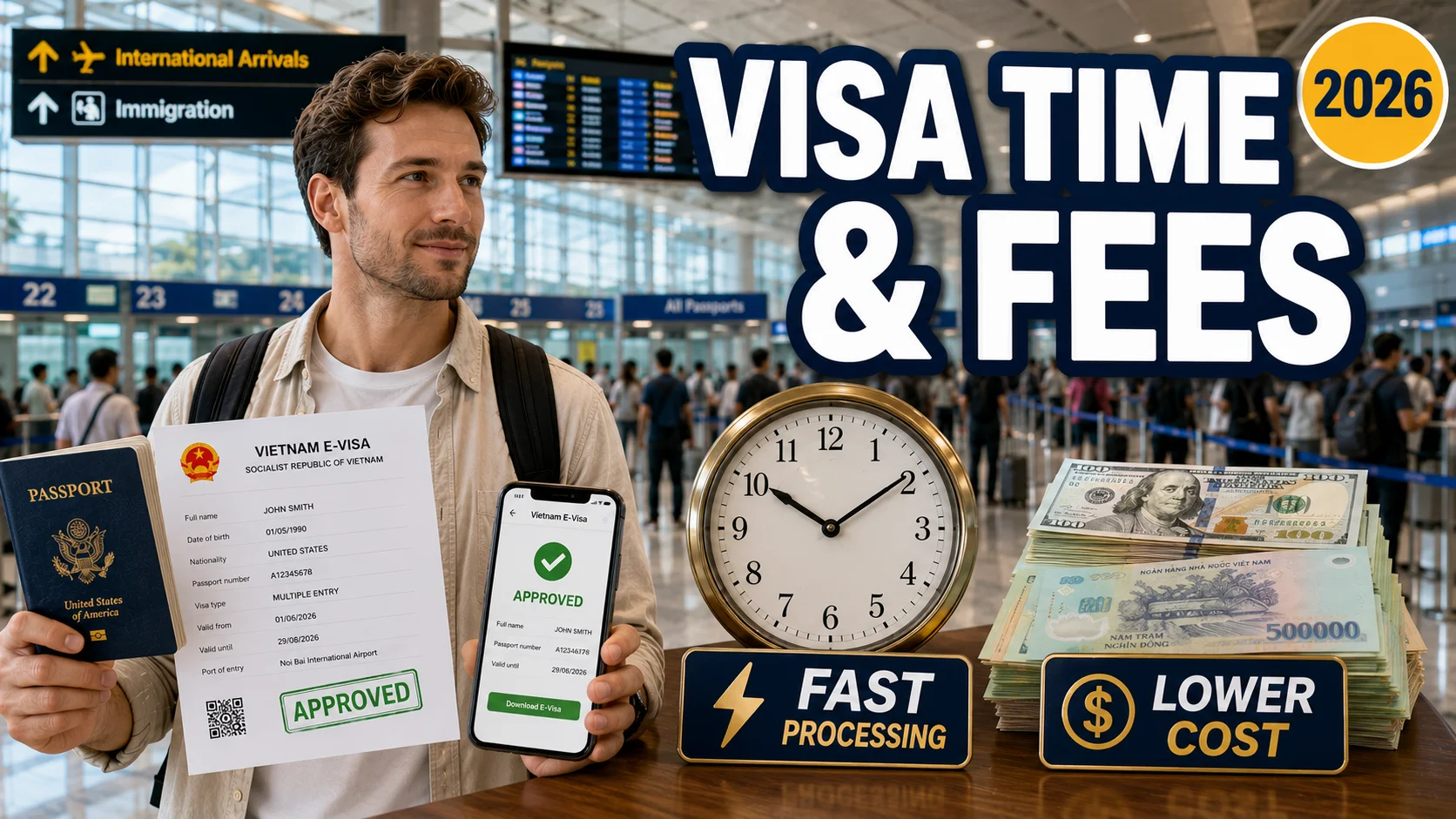
Vietnam visa pricing gets confusing fast, because there are really two separate cost layers stacked on top of each other: the fixed government fee (set by the Vietnam Immigration Department, the same for everyone) and a service fee (which varies by provider, and scales with how fast you need results). Mixing these two up — or not realizing urgency tiers exist at all — is the most common reason travelers either overpay or get caught out close to a flight.
This guide breaks down every option Vietnam Visabox offers, what determines the final price, and which service actually fits different situations — without repeating every pricing table in full, since each service’s dedicated page always has the current, exact numbers.
The Two Cost Layers, Explained
Government fee (fixed, non-negotiable, same everywhere):
- E-visa: $25 USD single entry / $50 USD multiple entry
- Visa on Arrival stamping fee: $25 USD single entry / $50 USD multiple entry, paid in cash at the airport counter
Service fee (varies by provider and speed): this covers document review, application submission, support, and — for faster tiers — prioritized processing. This is the part that changes significantly based on which service and processing speed you choose.
Quick Comparison: All 6 Services at a Glance
| Service | What It’s For | Typical Processing Time | Where to See Exact Current Pricing |
|---|---|---|---|
| Vietnam E-Visa | New application, standard timeline | 3–5 working days (faster tiers available) | E-Visa page |
| Vietnam Visa On Arrival | New application, air travel only, stamped at airport | A few working days for the approval letter, plus airport stamping on arrival | VOA page |
| Urgent Vietnam Visa | Brand-new application, haven’t applied yet, flight is close | As fast as 1 working hour under the right conditions | Urgent Visa page |
| E-Visa Expedited Service | Already applied, application stuck in “processing” | As fast as 1 working hour, up to 3 working days | Expedited Service page |
| Vietnam Tourist Visa | E-visa filed under Tourism purpose | Same as standard E-Visa | Same pricing as E-Visa |
| Vietnam Business Visa | E-visa filed under Business purpose | Same as standard E-Visa | Same pricing as E-Visa |
Vietnam E-Visa: The Baseline
The standard e-visa is the reference point for pricing everything else. Confirmed current tiers on our Vietnam E-Visa page: Standard processing (3–5 working days) starts at $49 single entry / $79 multiple entry, all-inclusive of the government fee. Faster tiers — Urgent (2 working days) and Super Urgent (1 working day) — cost progressively more, with a Rush Emergency option for same-day needs available on request.
Since Tourist and Business purposes are the same underlying e-visa product, their pricing is identical — the purpose field doesn’t change the cost, only the declared reason for entry. See our guide on choosing between them if you’re unsure which fits your trip.
Vietnam Visa On Arrival: A Different Fee Structure
VOA pricing works differently because it involves two separate payments: a service fee for the approval letter (paid in advance, online) and a stamping fee paid in cash at the airport — $25 for single entry, $50 for multiple entry. This split trips up first-time VOA users who budget only for the online portion and forget they’ll need cash on hand at immigration. See our Vietnam Visa On Arrival page for current service fee tiers.
Urgent Vietnam Visa: For Applications You Haven’t Started Yet
If you haven’t applied at all and your flight is close, Urgent Vietnam Visa processes a brand-new application on an accelerated timeline. Because pricing here depends heavily on how close your flight is and which processing window your request falls into, exact current rates are best confirmed directly on that page or by messaging a specialist — this is a case where a quick conversation gets you a more accurate number than a static table would.
E-Visa Expedited Service: For Applications Already Submitted
This is the one service on this list with fully published, fixed tiers, since it depends only on processing speed rather than nationality or flight timing variables:
| Processing Time | Fee (per person) |
|---|---|
| 1 working hour | $125 |
| 2 working hours | $95 |
| 4 working hours | $75 |
| 8 working hours | $55 |
| 2 working days | $45 |
| 3 working days | $35 |
Important: these fees are separate from — and in addition to — the government e-visa fee, which should already be paid from your original application. Full details on our E-Visa Expedited Service page.
What Actually Determines Your Final Price
A few variables move the total cost more than people expect:
- Single vs. multiple entry — multiple entry costs more upfront but avoids needing a second application if you plan to exit and re-enter Vietnam during your trip
- Processing speed — the biggest cost swing by far; standard processing is always the cheapest option if your timeline allows it
- New application vs. accelerating an existing one — these are genuinely different services (Urgent Visa vs. Expedited Service) and confusing them can mean paying for the wrong one
- VOA’s airport-side cash fee — easy to forget when comparing “sticker price” service fees online
The Cheapest Path, by Situation
“I’m planning ahead, no rush.” Standard e-visa processing (3–5 working days) is the lowest-cost option across the board — there’s no reason to pay for speed you don’t need.
“My flight is in 2 days and I haven’t applied.” Compare Urgent Visa against VOA for your specific airport — for air travel, VOA’s speed can sometimes be competitive, but confirm current quotes for both before deciding, since pricing on time-sensitive services shifts with demand.
“I already applied and it’s stuck in processing.” Expedited Service is almost always the right (and cheaper) call here — reapplying via Urgent Visa when you already have a pending application typically costs more than accelerating what you’ve already submitted.
“I want to minimize total cost and I’m flexible on dates.” Choose standard processing and apply at least a week before departure — this avoids every urgency surcharge entirely.
A Word on “Too Good to Be True” Pricing Elsewhere
If you see e-visa service fees advertised well below the government fee itself, or “guaranteed approval” language attached to unusually low pricing, treat that as a red flag rather than a deal. No legitimate service can charge less than the fixed $25/$50 government fee and still cover it — pricing that doesn’t add up usually means a hidden second charge later, or a site that isn’t actually processing anything through official channels.
A Worked Example: Comparing Total Cost for the Same Trip
To make this concrete, consider a traveler planning a 2-week holiday, deciding between three approaches for the same single-entry e-visa:
- Applying directly on the government portal, standard timeline: just the $25 government fee, with no service support if anything goes wrong — the cheapest option, but with the most personal risk if a document error causes a delay
- Applying through a reviewed service, standard timeline: the $25 government fee plus a modest service fee (document review, submission, and support included) — still relatively low cost, with meaningfully lower risk of a costly last-minute scramble
- Applying through a reviewed service, urgent timeline, 2 days before departure: the same $25 government fee, but with a significantly higher service fee reflecting the accelerated processing
The gap between the first and third options can be substantial — often several times the baseline cost — and the difference comes down entirely to how much lead time you give yourself, not the underlying visa itself. This is the single biggest lever travelers have over their own total cost.
Costs People Forget to Budget For
Beyond the headline visa fee, a few related costs catch travelers off guard if they’re not accounted for upfront:
- VOA’s cash-only stamping fee — no cards accepted at the airport counter for this specific charge, and there’s typically no ATM inside the customs area itself, so arriving without cash on hand can become a real problem
- Photo retakes — if your uploaded photo doesn’t meet specifications, some services charge for review but not for correcting and resubmitting a new photo; confirm this before applying if it’s a concern
- Airport Fast Track — a separate, optional cost entirely unrelated to your visa, but often bundled into travelers’ mental “total Vietnam entry cost” when planning a budget
- Currency conversion fees — paying in USD versus your home currency can carry a card conversion fee depending on your bank, worth checking before paying online
None of these are hidden fees in the deceptive sense — they’re simply costs that live outside the visa fee itself, and budgeting for them upfront avoids surprises.
Frequently Asked Questions
1. What’s the absolute minimum I’ll pay for a Vietnam e-visa? The government fee itself — $25 single entry or $50 multiple entry — if applying directly through the official portal with no service fee. Using a review/support service adds a modest fee on top.
2. Is Visa on Arrival cheaper than an e-visa? Not necessarily — VOA involves two separate payments (an online service fee plus a cash stamping fee at the airport), and total cost is often comparable to or higher than an e-visa once both are added together.
3. What’s the difference between Urgent Visa and Expedited Service, pricing-wise? They solve different problems — Urgent Visa is a new application processed quickly; Expedited Service accelerates an application you’ve already submitted. Using the wrong one for your situation typically costs more than necessary.
4. Does choosing Tourist or Business purpose change the price? No. Both are the same e-visa product with the same pricing — only the declared purpose of entry differs.
5. Why do I need cash for Visa on Arrival if I already paid online? The online payment covers your approval letter service fee; the $25/$50 stamping fee is a separate government charge paid in cash directly at the airport counter.
6. Is the fastest processing tier always worth the extra cost? Only if your timeline genuinely requires it. If you have several days before departure, standard processing achieves the same result for less.
7. Are government fees the same no matter which service I use? Yes — the $25/$50 government e-visa fee (and the same stamping fee for VOA) is fixed and identical regardless of which service provider you use.
8. What if I can’t tell whether I need Urgent Visa or Expedited Service? Check whether you’ve already submitted an application — if yes, and it’s showing “processing,” that’s Expedited Service. If you haven’t applied at all, that’s Urgent Visa.
9. Is there a cheaper option if I’m not in a hurry? Yes — standard e-visa processing is consistently the lowest-cost path across every service compared here.
10. Where can I get an exact, current quote for my specific situation? Each service’s dedicated page has current pricing, and messaging a specialist directly is the fastest way to get an exact number for urgent or time-sensitive requests specifically.
Not Sure Which Service Fits Your Budget and Timeline?
Tell us your situation — flight date, whether you’ve already applied, and how much flexibility you have — and we’ll point you to the most cost-effective option rather than the most expensive one.
👉 Message us on WhatsApp or by email
Ready to apply? Start with Vietnam E-Visa. Need speed? See Urgent Visa or Expedited Service. Prefer a stamped visa? See Visa On Arrival.
This article is for general informational purposes and reflects publicly available guidance current at the time of writing. Government fees and service pricing can change; always confirm current rates on the relevant service page before applying.
