
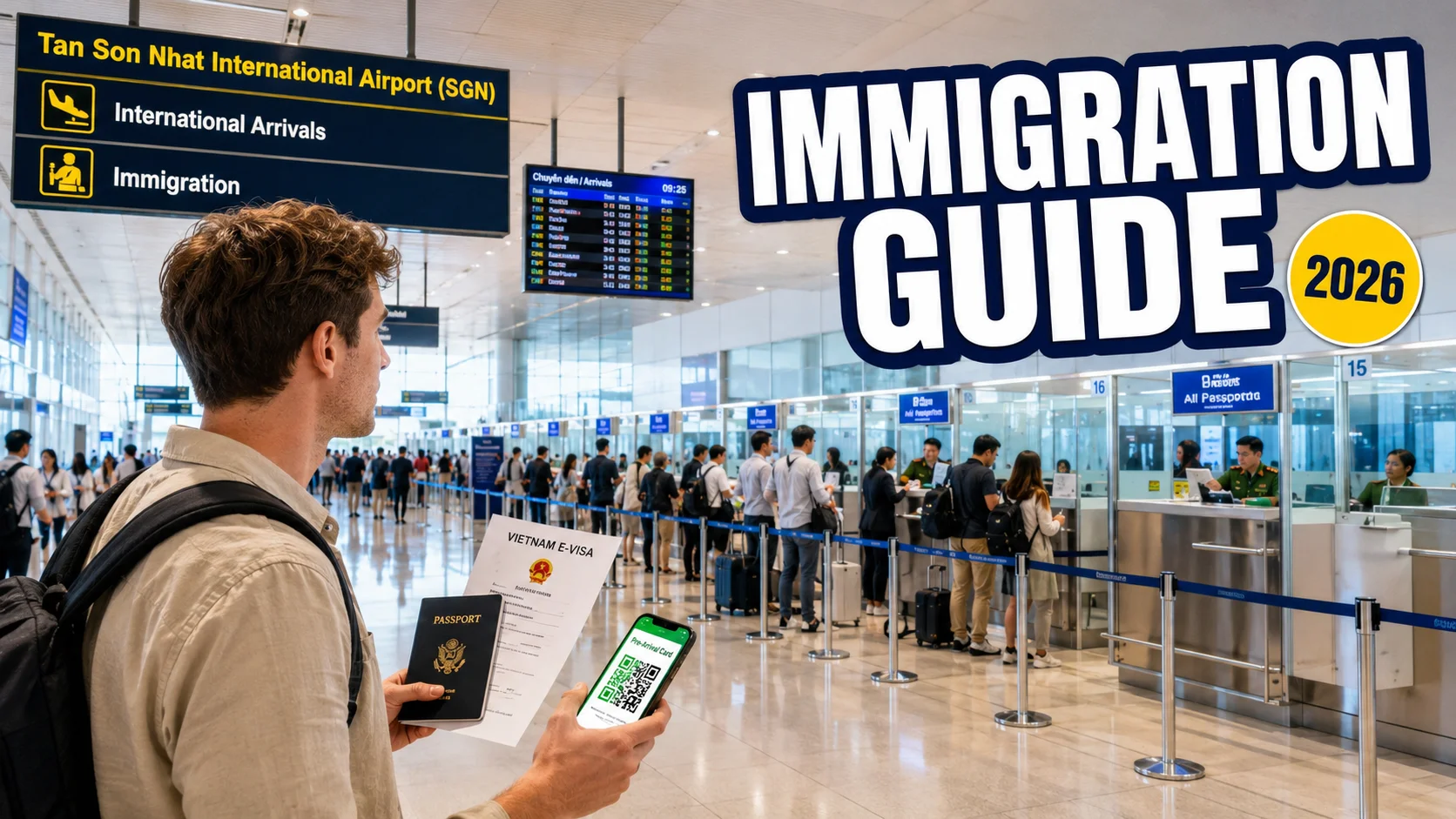
Your First Half-Hour (or Hour) in Vietnam
For most international travelers, Tan Son Nhat International Airport (SGN) in Ho Chi Minh City is the first real experience of Vietnam — and immigration is the first checkpoint of that experience. It’s generally straightforward once you know what to expect, but SGN is also the busiest airport in the country, and queues here run noticeably longer than at Vietnam’s smaller airports, particularly during peak evening arrivals.
This guide walks through exactly what happens after you land — the physical layout, realistic wait times by hour, what officers actually check, and the handful of mistakes that catch first-time arrivals off guard.
Where You’ll Land: Terminal 2
Almost all international flights at Tan Son Nhat arrive at Terminal 2 — Terminal 1 is dedicated to domestic flights within Vietnam. The terminal is modern, with clear English and Vietnamese signage throughout, and the arrival sequence follows a fixed order:
- Disembark and walk to immigration — signage directs arriving passengers clearly toward passport control
- Immigration (passport control) — present your passport and required documents at a manual counter
- Health screening — a quick checkpoint immediately after immigration (see the note on health declarations below)
- Baggage claim — located just below the immigration hall
- Customs — a final checkpoint, sometimes involving an X-ray scan of luggage
- Arrival hall — currency exchange, SIM card kiosks, and transport options are all available here
Under light traffic, this entire sequence can take well under an hour door to door. Under heavy traffic, immigration alone can take considerably longer — which is the part worth planning around.
Realistic Immigration Wait Times in 2026
This is the detail most travel guides gloss over, so it’s worth being specific. Based on recent 2026 arrival patterns:
| Time Window | Typical Wait |
|---|---|
| 17:00–21:00 (evening peak) | 60–120+ minutes — the most congested window, driven by simultaneous arrivals from Northeast and Southeast Asian routes |
| 08:00–11:00 (morning) | A close second for congestion |
| 11:00–14:00 | Generally the lightest window, if your schedule allows flexibility |
| Tet (Lunar New Year) period | Can extend to 130–150 minutes even outside the usual evening peak |
Under normal, off-peak conditions, immigration processing itself typically runs 10 to 30 minutes. The wide range you’ll see across different sources for SGN specifically comes down to this same underlying cause every time: wave arrivals — several wide-body flights from major regional hubs landing within the same 30–45 minute window, all funneling into the same limited number of counters.
Why foreign travelers wait longer than Vietnamese citizens: since early 2026, Vietnamese passport holders can use autogate (automated, biometric passport gates), while the large majority of foreign nationals still go through manual officer processing, which takes roughly 90 seconds to 3 minutes per traveler. With hundreds of arriving passengers during a wave, that per-person processing time adds up quickly.
What Immigration Officers Actually Check
At the counter, be ready to present:
- Your passport, valid for at least 6 months beyond your planned exit date
- Your visa or entry document — an approved e-visa printout, a Visa on Arrival approval letter (processed at a separate VOA counter first, not the main line), or simply your passport if you’re entering visa-exempt
- Your Pre-Arrival Card QR code, if applicable (see below)
The process itself is simple if your documents are in order: present everything, answer any brief questions asked, and you’re stamped through. Complications generally arise from documentation issues — not from the immigration process itself being complicated.
The Pre-Arrival Card: Don’t Skip This Step
Since 15 April 2026, most foreign travelers arriving at Tan Son Nhat must complete a free, mandatory online declaration before reaching immigration — separate from your visa. It generates a QR code that speeds up the officer’s review of your details.
Completing it the night before your flight, rather than at the airport, is the difference between walking straight to the counter and stopping to fill out a kiosk form after a long-haul flight. We cover the full requirements, eligibility, and step-by-step process in our dedicated guide: Vietnam Pre-Arrival Card Ho Chi Minh City 2026.
A Note on Health Declarations
Vietnam introduced a legal framework in mid-2026 (Decree No. 165/2026/NĐ-CP, effective 1 July 2026) allowing the Ministry of Health to require a health declaration during a specific disease outbreak. This is not a routine, blanket requirement — it only activates if a specific health situation is officially declared. If you’re travelling during a period when this might apply, it’s worth checking official government channels closer to your departure date, since this kind of requirement can be introduced or lifted on short notice.
Common Arrival Mistakes at Tan Son Nhat
A handful of avoidable mistakes show up repeatedly among first-time arrivals:
Underestimating immigration wait times. Some travelers plan connections or pickups assuming a 20-minute process, without accounting for SGN’s specific peak-hour congestion — this is the single most common planning error.
Treating an international-to-domestic connection as a simple transfer. Unlike airports with true airside international-to-domestic transfers, connecting through SGN to a domestic Vietnamese flight requires clearing full immigration, collecting baggage, and moving to a separate terminal — realistically needing 3–4 hours, not the 90 minutes travelers sometimes assume.
Joining the main immigration queue by mistake when holding a Visa on Arrival approval letter. VOA travelers need to visit a separate stamping counter first, before joining the general immigration line — skipping this step typically means being redirected back to restart the process.
Not confirming whether the Pre-Arrival Card (and health declaration, if activated) has been completed before flying. Both can affect how smoothly you move through entry at Tan Son Nhat specifically.
Customs and What Not to Bring Through
After immigration and baggage claim, most travelers pass through customs without incident, but a few categories consistently cause delays or confiscation for first-time visitors:
- Fresh fruit, meat, or plant material brought from your home country is generally not allowed through agricultural quarantine controls, even in small personal quantities
- Large amounts of undeclared cash (typically above a threshold set by Vietnamese customs regulations) should be declared on arrival rather than risk questioning later
- Drones and certain electronics occasionally draw extra scrutiny and may require documentation depending on current customs guidance — checking your airline or the Vietnamese customs authority’s current rules before packing is worth the few minutes it takes
None of these are unique to Tan Son Nhat specifically, but they’re worth knowing before you land here, since a customs hold at the country’s busiest airport tends to feel more disruptive than the same situation elsewhere.
Planning Around Tet and Other Peak Travel Periods
Beyond the daily 17:00–21:00 congestion window, certain calendar periods reliably push Tan Son Nhat’s immigration halls well beyond typical peak-hour waits. Tet (Lunar New Year) is the clearest example — with waits extending to 130–150 minutes even outside the usual evening rush, driven by a combination of overseas Vietnamese returning home, increased regional tourism, and a general spike in air travel across the whole Southeast Asian region during the same roughly two-week window.
If your travel dates land during Tet, or close to other major Vietnamese public holidays, it’s worth building extra buffer time into airport pickups, onward domestic connections, and any tightly scheduled plans for the day you arrive. This is also the period where the gap between standard immigration and a Fast Track service tends to be most pronounced, simply because the underlying congestion is more severe than an average evening.
Should You Use Airport Fast Track?
Given SGN’s specific congestion pattern — long evening waves, manual processing for foreign nationals, and a genuinely busy terminal — many travelers weigh whether a paid Fast Track service is worth it for their arrival. A staff member meets you at the aircraft door or jet bridge and guides you through a dedicated priority lane, entirely separate from visa processing.
Whether it’s worth it depends on your arrival time, group size, and how much an unpredictable hour (or more) matters to your onward plans. We cover this decision — including realistic cost-versus-time-saved math — in our general guide, What Is Airport Fast Track in Vietnam — and Is It Worth It?, and you can see exact packages and current pricing specific to this airport on our Tan Son Nhat Airport Fast Track page.
Getting From the Airport Into Ho Chi Minh City
Tan Son Nhat sits only about 6–8 km from the city center, and the trip typically takes 20–40 minutes depending on traffic. Reputable metered taxis and ride-hailing apps (such as Grab) are both widely available directly outside the arrival hall — ride-hailing apps generally offer more predictable, transparent pricing, which is worth considering after a long flight when negotiating isn’t appealing.
Frequently Asked Questions
1. How long does immigration take at Tan Son Nhat Airport? Under normal conditions, 10–30 minutes. During peak windows (especially 17:00–21:00), waits of 60–120 minutes are common, and can extend further during Tet.
2. Which terminal do international flights use at SGN? Terminal 2. Terminal 1 handles domestic flights only.
3. Do I need to complete the Pre-Arrival Card before landing at Tan Son Nhat? Yes, for most foreign travelers, since 15 April 2026. It’s a separate declaration from your visa — see our full guide for details.
4. Can I use autogate as a foreign national at SGN? Generally not yet — autogate is currently mandatory for Vietnamese passport holders, while most foreign nationals go through manual officer processing.
5. What’s the best time to arrive to avoid long queues? The 11:00–14:00 window is typically the lightest. The 17:00–21:00 evening window is consistently the most congested.
6. I have a Visa on Arrival — do I join the same queue as everyone else? No. VOA travelers need to visit a separate stamping counter first to have their visa issued, before joining the general immigration queue.
7. Is a health declaration required to enter Vietnam through SGN? Not routinely. A legal framework introduced in 2026 allows this to be activated only during a specific declared health situation — check official channels if your travel dates might coincide with one.
8. How long does an international-to-domestic connection take at SGN? Plan for 3–4 hours, since it requires clearing full immigration, collecting baggage, and moving to a separate terminal — it is not a simple airside transfer.
9. Is Airport Fast Track worth it for Tan Son Nhat specifically? Many travelers find it worthwhile given SGN’s evening peak congestion and manual-only processing for foreign nationals, particularly if travelling with family, during peak hours, or with a tight onward connection.
10. How do I get from Tan Son Nhat into Ho Chi Minh City? Metered taxis and ride-hailing apps like Grab are both available directly outside the arrival hall, with the trip typically taking 20–40 minutes depending on traffic.
Preparing for Your Arrival at Tan Son Nhat?
Getting your visa, Pre-Arrival Card, and arrival plan sorted in advance makes the actual immigration process the easy part. Let us help with whichever piece you still need.
👉 Message us on WhatsApp or by email
Need your visa sorted first? See our Vietnam E-Visa or Vietnam Visa On Arrival pages. Want a smoother arrival? See Tan Son Nhat Airport Fast Track.
This article is for general informational purposes and reflects publicly available guidance current at the time of writing. Immigration procedures, wait times, and health requirements can change; always confirm current details before travelling.
