
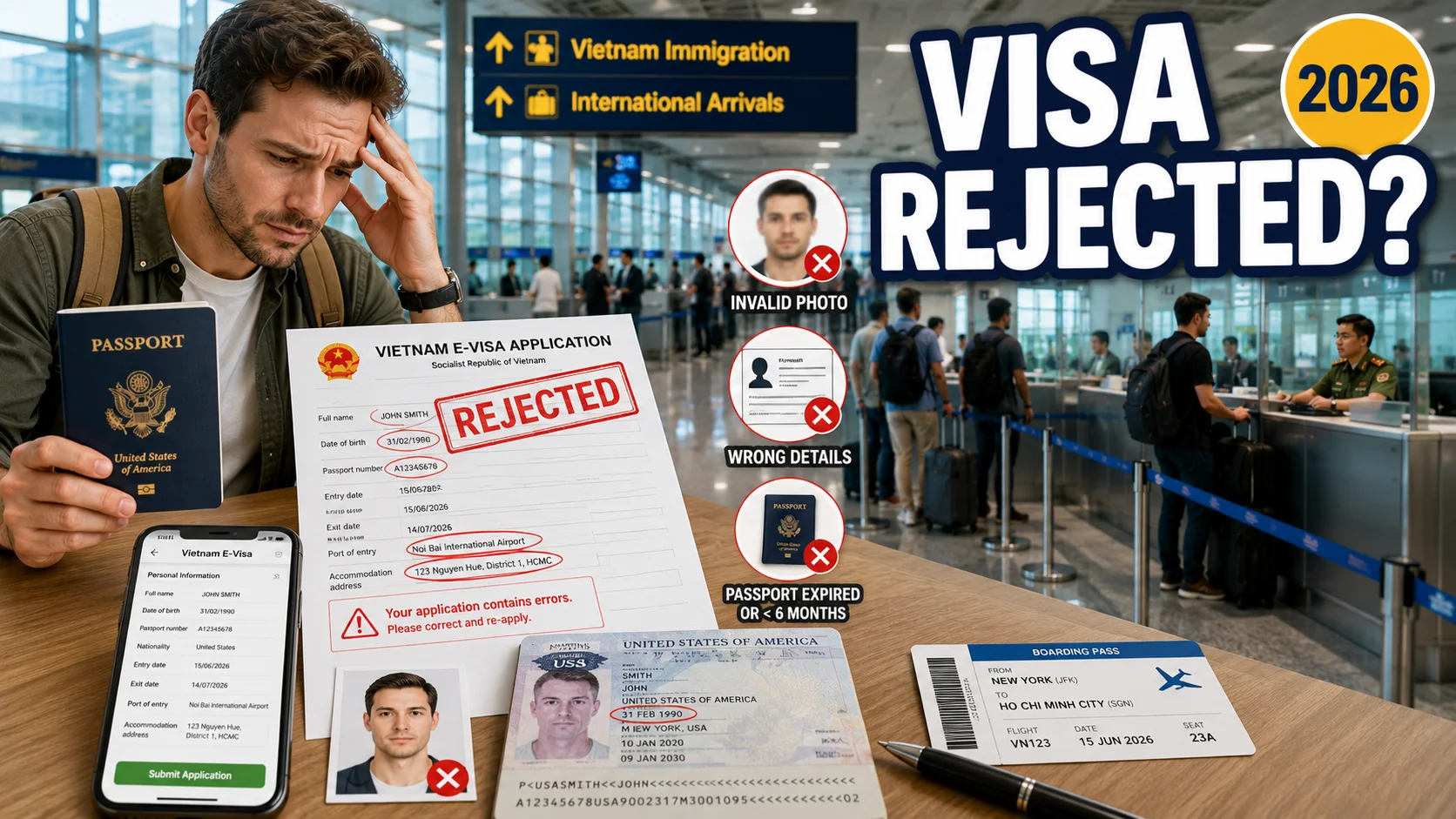
Why Small Errors Cause Big Delays
The Vietnam e-visa system has one unforgiving trait: once you submit, you generally can’t edit it. A small typo, a slightly-off photo, or a mismatched date doesn’t get quietly corrected by an immigration officer — it either triggers a manual review that adds days to your processing time, or results in outright rejection, sending you back to square one.
The good news is that almost every rejection or delay traces back to one of a small, predictable set of mistakes. We review applications for a living, and these 10 issues account for the overwhelming majority of problems we see. Catching them before you submit is the difference between a 3-day approval and a week of back-and-forth right before your flight.
1. Non-Compliant Photos
Photo issues cause more delays than any other single factor. Common problems include photos that are blurry, poorly lit, cropped awkwardly, taken with glasses on, or shot against a background that isn’t plain white. A frequent specific mistake: applicants crop their portrait photo directly from an existing picture rather than taking a proper, dedicated photo — this often results in a low-resolution, distorted image that reviewers can’t clearly assess.
How to avoid it: Take a fresh photo specifically for this purpose, ideally within the last 6 months, on a plain white background, facing the camera directly, with no glasses or head coverings (except for religious reasons). Check the full photo specifications before uploading.
2. Uploading the Wrong Photo to the Wrong Field
The e-visa application has two separate photo uploads: your portrait photo and your passport data page. A surprisingly common mistake is uploading the same image to both fields, or swapping them — the portrait goes into the passport-page field and vice versa. This forces manual correction and pushes your application into a slower review queue.
How to avoid it: Double-check both upload fields before submitting — the portrait should be a close-up of your face, and the passport photo should clearly show your entire data page.
3. A Passport Scan That Doesn’t Show the Full ICAO Lines
At the bottom of your passport’s data page are two rows of machine-readable text — the ICAO lines. If your scan cuts these off, blurs them, or catches glare across them, your application is likely to be returned for a clearer copy. This happens most often when travelers photograph their passport at an angle, in poor lighting, or too close to fit the whole page.
How to avoid it: Photograph your passport flat, under even lighting, with the entire page — including both ICAO lines at the bottom — clearly visible and in focus.
4. Personal Details That Don’t Match Your Passport Exactly
This is one of the most common — and most avoidable — reasons applications stall. The system cross-references what you type against your uploaded passport scan, and any mismatch can trigger manual review or delay. Typical culprits include:
- Misspelled names, or names entered in the wrong order
- An incorrect date of birth
- Dates entered in the wrong format — Vietnam’s form uses DD/MM/YYYY, but travelers used to the US MM/DD/YYYY format sometimes enter dates incorrectly without noticing
- A passport number typed incorrectly
How to avoid it: Type every field directly from your passport, character by character, and read the whole form back before submitting — don’t rely on autofill or memory.
5. A Passport That Doesn’t Meet the 6-Month Validity Rule
Vietnam requires your passport to remain valid for at least 6 months beyond your planned exit date — not just your entry date. Applicants sometimes check only that their passport is valid on the day they arrive, without accounting for the full length of their trip plus the 6-month buffer, and get rejected as a result.
How to avoid it: Add your planned exit date plus 6 months, and confirm your passport’s expiry falls after that combined date. If it doesn’t, renew your passport before applying.
6. A Blank, Vague, or Guessed Accommodation Address
The accommodation address field trips up more travelers than it should. Leaving it blank, entering a vague answer, or guessing at a district you’re not confident about are all common reasons applications get held for additional review.
How to avoid it: Copy your accommodation address directly from a hotel booking confirmation. If your specific area isn’t listed as an option, choose the nearest major district rather than leaving the field blank or picking one at random.
7. Selecting the Wrong Purpose of Entry
Vietnam’s e-visa requires selecting a purpose — most commonly Tourism or Business Activities. Selecting the wrong one doesn’t usually cause outright rejection, but it can create complications if your actual activity in Vietnam doesn’t match what you declared, and it can’t be changed after submission. See our guide on choosing between Tourist and Business purpose if you’re unsure which fits your trip.
How to avoid it: Select the purpose that genuinely matches your primary reason for travelling, not whichever seems simpler to apply for.
8. Applying While Physically Inside Vietnam
Vietnam e-visa applications must be submitted from outside the country. Applicants who are already in Vietnam — perhaps trying to extend or convert their status — and submit a new e-visa application from inside the country will have it automatically rejected.
How to avoid it: If you’re already in Vietnam and need a different visa arrangement, that requires a different process entirely (such as working with immigration authorities on an extension or conversion), not a new e-visa application filed locally.
9. Submitting a Duplicate Application While One Is Already Pending
Under time pressure, travelers sometimes submit a second e-visa application because the first one seems to be taking too long — without realizing the first is still active and processing normally. This creates two live applications tied to the same passport, which can cause confusion during review rather than speeding anything up.
How to avoid it: Before submitting a new application, check your email for a government application code from your original submission. If you already have one pending, an expedited processing service is the correct next step — not a duplicate application.
10. Misunderstanding When Your Visa Validity Actually Starts
A surprisingly common misconception is assuming an e-visa’s validity begins on the date you’re approved, rather than the entry date you specified on your application. Some travelers arrive close to their visa’s expiry, assuming they have the visa’s full duration remaining from the day they land — and find their actual window is shorter than expected, since the countdown was already running from the date on the visa, not their arrival.
How to avoid it: Check your approved e-visa’s exact validity dates as printed on the document itself, not the date you were approved or the date you applied — your permitted stay is calculated from the entry date on the visa.
A Quick-Reference Table: How Serious Is Each Mistake?
Not every mistake carries the same weight. Some cause a short delay for manual review; others lead to outright rejection. Here’s a rough guide to what typically happens with each:
| Mistake | Typical Outcome |
|---|---|
| Non-compliant photo | Delay for manual review or correction request |
| Photo uploaded to wrong field | Delay while the system flags the mismatch |
| ICAO lines not visible | Application returned for a clearer scan |
| Personal details mismatched | Delay, or rejection if the discrepancy looks significant |
| Passport validity under 6 months | Rejection — this is a hard requirement |
| Blank/vague accommodation address | Held for additional review |
| Wrong purpose of entry | Approved as submitted, but can cause issues at immigration later |
| Applying from inside Vietnam | Automatic rejection |
| Duplicate application submitted | Processing confusion, not automatic rejection, but avoidable |
| Misunderstanding validity start date | No rejection, but can shorten your actual usable stay |
Beware of “Guaranteed Approval” Services
One mistake worth flagging separately, since it’s less about the form itself and more about who you trust with it: be cautious of any service promising “guaranteed approval” through unusual means, or asking you to submit false information to improve your chances. Vietnam’s e-visa system checks applications against immigration records, and no legitimate service can bypass that process or guarantee an outcome it doesn’t control. Similarly, official e-visa correspondence only comes from Vietnam’s national e-visa system — if you receive a request for an unexpected second payment, verify it carefully rather than paying automatically, since duplicate or scam payment requests are a known pattern applicants encounter.
What to Do If Your Application Is Already Rejected or Delayed
If you’ve already run into one of these issues, a few things are worth knowing:
- Vietnam does not typically send proactive email updates for every status change — checking your application status manually on the official portal (or asking a specialist to check on your behalf) is often necessary rather than waiting for a notification.
- There is generally no formal appeal process for a rejected e-visa. The standard path is correcting the underlying issue and submitting a fresh, accurate application.
- If your flight is close and your current application is genuinely stuck (not rejected, just slow), our Expedited Service accelerates an existing pending application rather than requiring you to start over.
Frequently Asked Questions
1. Can I edit my Vietnam e-visa application after submitting it? Generally no — once submitted, most fields can’t be changed. This is why checking every detail carefully before submission matters so much.
2. What’s the single most common reason for e-visa delays? Photo issues and mismatched personal details are consistently the two biggest categories, together accounting for the large majority of delays we see.
3. Is there a formal appeal process if my e-visa is rejected? No, there is generally no formal appeal system. The standard approach is identifying and correcting the issue, then submitting a fresh application.
4. How do I check my application status if I haven’t heard anything? Check the official government portal directly using your application code — Vietnam does not always send proactive status update emails, so manual checking is often necessary.
5. What if I realize I made a mistake right after submitting? Contact support or a specialist immediately to flag the issue, rather than waiting to see if it’s caught during review — early awareness sometimes allows for a faster resolution.
6. Can children be added to a parent’s e-visa application? Only if the child’s name is physically printed inside the parent’s own passport. Children who hold their own separate passport need their own separate e-visa application.
7. Does a rejected application mean I can never get a Vietnam e-visa? No. A rejection is almost always fixable — identifying the specific cause and submitting a corrected application typically resolves it, with no mandatory waiting period before reapplying.
8. Should I reapply immediately if my application is rejected? Only after identifying and correcting the actual cause. Reapplying with the same error unresolved usually leads to the same outcome.
9. What if I’m not confident preparing the photos or filling in the form myself? A specialist review before submission can catch these issues in advance — this is exactly the kind of check that prevents delays rather than fixing them after the fact.
10. Is a slow “processing” status the same as a rejection? No. “Processing” means your application is still moving through the normal queue — it hasn’t been rejected. If your flight is close and it’s taking longer than expected, expedited processing is the appropriate next step, not a new application.
Want Your Application Checked Before You Submit?
Avoid the back-and-forth entirely. Send us your documents and let a specialist review everything for these exact issues before you submit — it’s far faster than fixing a rejection later.
👉 Message us on WhatsApp or by email
Ready to apply? Start with our Vietnam E-Visa application service. Already submitted and running out of time? See our Expedited Service.
This article is for general informational purposes and reflects publicly available guidance current at the time of writing. Requirements can change; always confirm current details before applying.
