
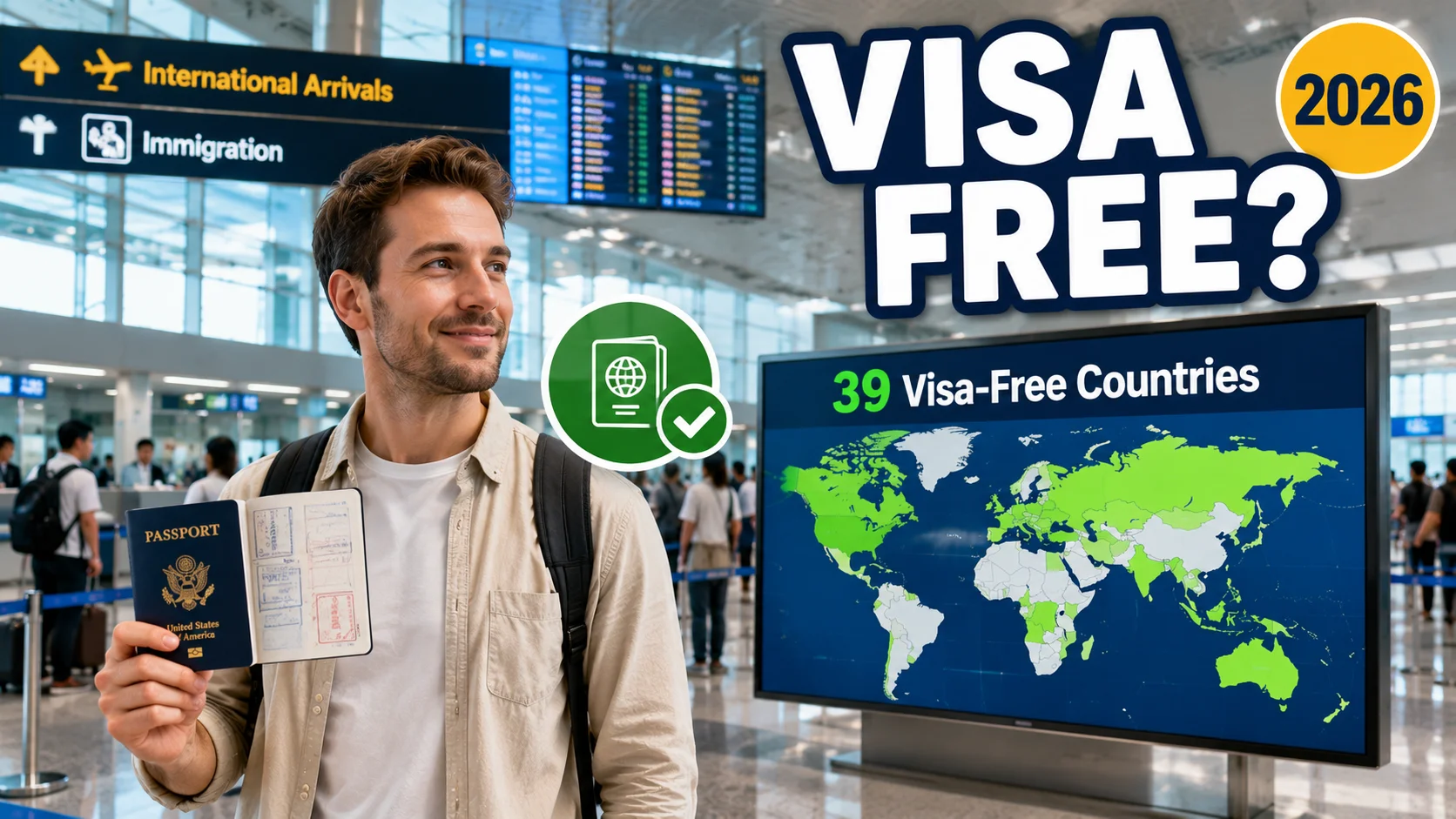
Before applying for anything, it’s worth checking one thing first: does your passport already let you into Vietnam without a visa? As of 2026, Vietnam grants visa-free entry to 39 nationalities, with permitted stays ranging from 14 to 90 days depending on your passport. If you’re on this list and your trip fits within the allowed duration, you don’t need an e-visa, a visa on arrival, or any application at all — just a passport that meets a few basic conditions.
This guide lists every eligible nationality, how long each one can stay, and what applies if your country isn’t on the list.
What Vietnam Visa Exemption Actually Means
Vietnam grants visa-free entry through two mechanisms: bilateral agreements, where both countries waive visa requirements for each other’s citizens, and unilateral policy, where Vietnam grants free entry regardless of whether the other country reciprocates. Most of the well-known exemptions — the UK, Japan, South Korea, and the 45-day European group — fall under this unilateral category.
The exemption covers tourism, family visits, and short business meetings only. It does not authorize paid work or study — those require a work permit or student visa arranged separately, in advance.
The Full List of 39 Exempt Countries (2026)
| Country | Maximum Stay | Entry Type |
|---|---|---|
| Chile | 90 days | Multiple |
| Panama | 90 days | Multiple |
| Belgium | 45 days | Multiple |
| Bulgaria | 45 days | Multiple |
| Croatia | 45 days | Multiple |
| Czechia | 45 days | Multiple |
| Denmark | 45 days | Multiple |
| Finland | 45 days | Multiple |
| France | 45 days | Multiple |
| Germany | 45 days | Multiple |
| Hungary | 45 days | Multiple |
| Italy | 45 days | Multiple |
| Japan | 45 days | Multiple |
| Luxembourg | 45 days | Multiple |
| Netherlands | 45 days | Multiple |
| Norway | 45 days | Multiple |
| Poland | 45 days | Multiple |
| Romania | 45 days | Multiple |
| Russia | 45 days | Multiple |
| Slovakia | 45 days | Multiple |
| Slovenia | 45 days | Multiple |
| South Korea | 45 days | Multiple |
| Spain | 45 days | Multiple |
| Sweden | 45 days | Multiple |
| Switzerland | 45 days | Multiple |
| United Kingdom | 45 days | Multiple |
| Belarus | 30 days | Multiple |
| Cambodia | 30 days | Multiple |
| Indonesia | 30 days | Multiple |
| Kazakhstan | 30 days | Multiple |
| Kyrgyzstan | 30 days | Multiple |
| Laos | 30 days | Multiple |
| Malaysia | 30 days | Multiple |
| Mongolia | 30 days | Multiple |
| Myanmar | 30 days | Multiple |
| Singapore | 30 days | Multiple |
| Thailand | 30 days | Multiple |
| Philippines | 21 days | Multiple |
| Brunei | 14 days | Multiple |
Not on the list: Australia, Canada, and the United States. Citizens of these three countries must apply for a visa — typically the Vietnam e-visa — for every trip to mainland Vietnam.
Breaking It Down by Region
Europe makes up the largest single bloc — 23 of the 39 exempt nationalities, with 22 receiving 45-day stays and Belarus on a separate 30-day allowance. One detail that surprises travelers: being part of the Schengen Area doesn’t automatically qualify you. Exemption is granted nationality by nationality through specific government decisions — citizens of Schengen countries not on this list, including Austria, Greece, Ireland, and Portugal, still need to apply for a visa.
ASEAN nations all receive visa-free entry, though durations vary: seven member states (Cambodia, Indonesia, Laos, Malaysia, Myanmar, Singapore, Thailand) get 30 days, the Philippines gets 21 days, and Brunei gets 14 days.
Outside Europe and ASEAN, the list is shorter: Japan and South Korea (45 days), Kazakhstan, Kyrgyzstan, and Mongolia (30 days), and Chile and Panama, which hold the longest exemptions of any nationality at 90 days.
How Long Can You Actually Stay?
Your permitted stay depends entirely on your passport:
- 14 days: Brunei
- 21 days: Philippines
- 30 days: Cambodia, Indonesia, Kazakhstan, Kyrgyzstan, Laos, Malaysia, Mongolia, Myanmar, Singapore, Thailand, Belarus
- 45 days: 22 European countries, plus Japan and South Korea
- 60 days: APEC Business Travel Card (ABTC) holders — a separate benefit from the standard exemption
- 90 days: Chile, Panama
Counting your stay: your entry date counts as Day 1, and your exit date is the final day. Arrive on 1 June with a 30-day exemption, and you need to leave by 30 June at the latest.
You cannot extend an exemption stay from inside Vietnam. If you need more time, your options are exiting and re-entering for a fresh exemption period (a “visa run”), or applying for the 90-day Vietnam e-visa before your next trip instead.
Entry Conditions at the Border
Being on the list doesn’t guarantee entry on its own — immigration officers also expect:
| Requirement | Details |
|---|---|
| Passport validity | At least 6 months beyond your entry date |
| Onward/return ticket | A confirmed ticket out of Vietnam |
| Proof of accommodation | Hotel booking, homestay confirmation, or an invitation letter |
| Clean immigration history | No prior overstay on a Vietnam visa or exemption |
| Sufficient funds | Immigration officers can ask for evidence; no fixed legal amount, though having some proof on hand is worth it |
The immigration officer at the port of entry has final discretion. Exemption is a policy-granted right, not an unconditional guarantee — if there’s reason to doubt your intentions, entry can be denied without a detailed explanation.
Single or Multiple Entry?
For nearly every exempt nationality, the exemption allows multiple entry — you can leave and return as often as you like, as long as each individual stay doesn’t exceed your permitted duration, with no mandatory waiting period between visits.
One caveat worth knowing: very frequent short border crossings (arriving, leaving the same day, returning immediately) can draw scrutiny from immigration officers, who may treat this pattern as an attempt to substitute repeated exemption stays for a genuine long-stay visa. If you’re planning an extended time in Vietnam, the 90-day e-visa is a cleaner option than repeated visa runs.
Visa Exemption vs. E-Visa: Which Applies to You?
If your nationality qualifies for exemption, you actually have a choice for shorter trips:
| Visa Exemption | Vietnam E-Visa | |
|---|---|---|
| Who can use it | 39 exempt nationalities only | All nationalities |
| Maximum stay | 14–90 days, by nationality | Up to 90 days |
| Cost | Free | Government fee applies |
| Application | None — present passport at entry | Online in advance |
| Processing time | None | A few working days (faster tiers available) |
If you qualify for exemption and your trip is 45 days or under, exemption is simpler — no form, no fee, no waiting. If you need longer than your exemption allows, or want a stamped document as formal proof of status for a landlord, bank, or employer, applying for the e-visa is worth considering even if you’re technically exempt. For a full breakdown of when each option makes sense, see our guide on E-Visa vs Visa On Arrival vs Visa Exemption.
US, Canadian, and Australian citizens have no exemption option — the e-visa is required for every mainland trip.
Special Cases Worth Knowing
Certificate of Visa Exemption (CVE) for overseas Vietnamese: Vietnamese nationals now holding a foreign passport, along with their spouse and children, can apply for a 5-year certificate through a Vietnamese embassy or consulate, allowing stays of up to 180 days per visit with unlimited re-entry. This is separate from the standard exemption list above and applies specifically to people of Vietnamese origin and their direct family.
Phu Quoc Island visa-free zone: Any nationality — including those not on the standard exemption list, such as US, Canadian, and Australian citizens — can stay on Phu Quoc Island for up to 30 days visa-free, provided they arrive directly by air or sea. The condition is staying on the island: travelling from Phu Quoc to mainland Vietnam during the same trip requires a valid e-visa for that portion. If Phu Quoc is your destination, our Phu Quoc Airport Fast Track page covers what to expect on arrival.
APEC Business Travel Card (ABTC) holders: A valid ABTC endorsed for Vietnam (marked “VNM”) grants 60 days of multiple-entry access — longer than the 45-day limit most standard exempt nationalities receive, making it a useful option for frequent business travelers who qualify.
Common Misconceptions Worth Clearing Up
A few misunderstandings come up often enough to address directly:
“My country is in the EU, so I must be exempt.” Not necessarily. Exemption is decided nationality by nationality, not by EU or Schengen membership as a bloc. Several EU countries — Austria, Greece, Ireland, and Portugal among them — are not currently on Vietnam’s exemption list, while others are.
“Visa exemption and visa-free are different things.” They’re the same thing, just described differently across sources — “visa exemption,” “visa waiver,” and “visa-free entry” all refer to the identical policy of entering Vietnam without applying for anything in advance.
“If I’m exempt, I don’t need any documents at all.” Exemption removes the need for a visa application, but not the standard entry conditions — passport validity, proof of onward travel, and accommodation details can all still be checked at the border, exemption or not.
“I can just keep doing visa runs indefinitely.” Technically possible for most nationalities since there’s no mandatory gap between exempt stays, but immigration officers can and do question travelers whose pattern looks like they’re using repeated short exemption periods to avoid ever holding a proper long-stay visa.
Frequently Asked Questions
1. Can US citizens get Vietnam visa exemption? Not for the mainland — US citizens need an e-visa for every trip. The one exception is Phu Quoc Island, where a direct arrival allows a visa-free stay of up to 30 days.
2. How many times can I enter Vietnam visa-free? For most exempt nationalities, as many times as you like, with no mandatory gap between visits — the only limit is that each individual stay can’t exceed your permitted duration.
3. Does visa exemption allow working or studying in Vietnam? No. It covers tourism, family visits, and short business meetings only. Working requires an employer-sponsored work permit; studying requires a separate student visa.
4. What happens if I overstay my exemption period? It’s treated as an immigration violation, carrying a fine and a possible re-entry ban that scales with the length of the overstay — there’s no grace period.
5. Is the exemption automatic, or do I need to apply for it? It’s automatic. No application or registration is needed — present a valid passport with at least 6 months’ validity at the port of entry and you’ll be stamped in for your permitted duration.
6. My country isn’t on the list — what should I do? Apply for the Vietnam e-visa, which is open to essentially every nationality worldwide and covers up to 90 days.
7. I qualify for exemption, but I want to stay longer than it allows — what then? Apply for the 90-day e-visa in advance rather than relying on exemption, since exemption periods can’t be extended from inside Vietnam.
8. Does being in the Schengen Area mean my country is exempt? No. Exemption is granted nationality by nationality, not by regional bloc — some Schengen countries qualify and others don’t, so check your specific nationality rather than assuming.
9. Can I use visa exemption to visit Phu Quoc and the mainland in the same trip? Only the Phu Quoc portion is covered by the island’s visa-free zone if you’re not otherwise exempt — travelling on to the mainland requires a valid e-visa for that part of the trip.
10. Where can I double check if anything has changed? Exemption lists are set by Vietnamese government decision and can be updated over time — check the official portal at evisa.gov.vn or message a specialist before booking if your trip depends on a specific exemption duration.
Not on the List, or Need More Than Your Exemption Allows?
If your nationality isn’t exempt, or your trip runs longer than your allowed stay, the Vietnam e-visa covers you for up to 90 days, with fast processing options available if you’re short on time.
👉 Message us on WhatsApp or by email
This article reflects publicly available guidance current at the time of writing. Vietnam’s visa exemption list and permitted stay durations are set by government decision and can change; always verify current details for your specific nationality before booking travel.
